Saturday, March 14, 2020: Gran Via, Madrid, Spain: The U.S. president had just announced the travel restrictions that would come into effect on March 13, and my colleagues, with whom I was sharing a swanky rental apartment high over Gran Via, had been on the phone for hours trying to get flights before their scheduled March 14 return. One succeeded in rebooking for a March 13 flight; the other two ended up leaving as scheduled, on Saturday, March 14th — although they upgraded their seats in order to get some enjoyment out of the flight before the chaos they knew would greet them in LAX. Meanwhile, below us in the city, the pharmacist around the corner had started wearing a facemask. Antiseptic wipes, hand sanitizer, and thermometers were utterly unavailable. One of the big flashing marquees on the Gran Via, normally lit up with video advertising, showed a COVID-19 warning. Coronavirus fliers were showing up on the metro tunnel walls. Restaurants had just been closed, and the wide main street, normally bustling with tourists, had emptied.
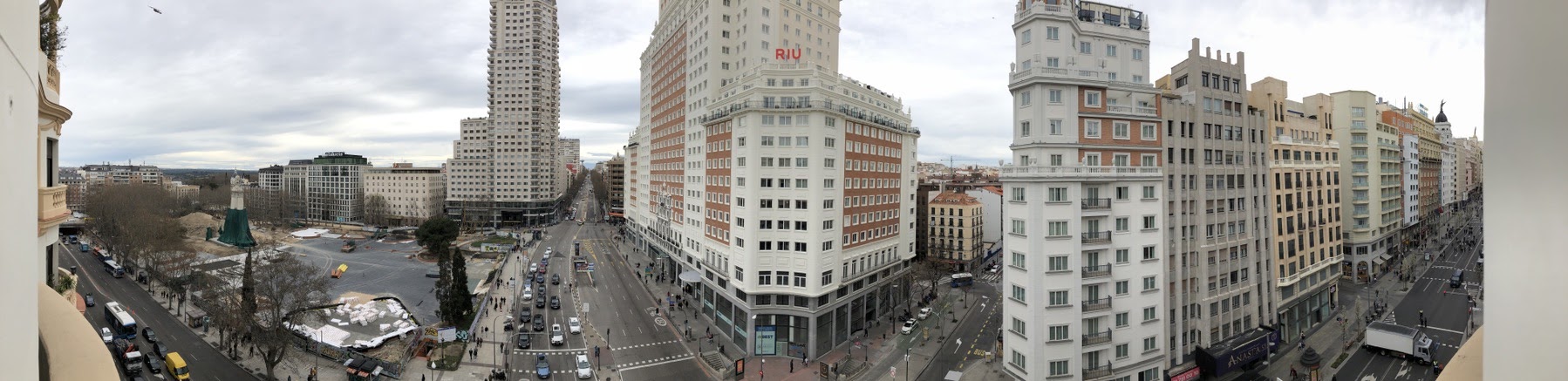
View from our apartment over the Gran Via, Madrid

View from our apartment over the Gran Via, Madrid

Electronic sign on the Gran Via

Electronic sign on the Gran Via

Signs in the metro tunnels

Signs in the metro tunnels

After my friends had left to catch their taxi to the airport, I was alone in the apartment. I’d been traveling with others since February 3, and I felt both some apprehension and excitement about beginning the solo leg of my journey. When it was finally time to leave, I shouldered my backpack, wrapped a scarf around my nose and mouth, and headed down to the nearby metro station.
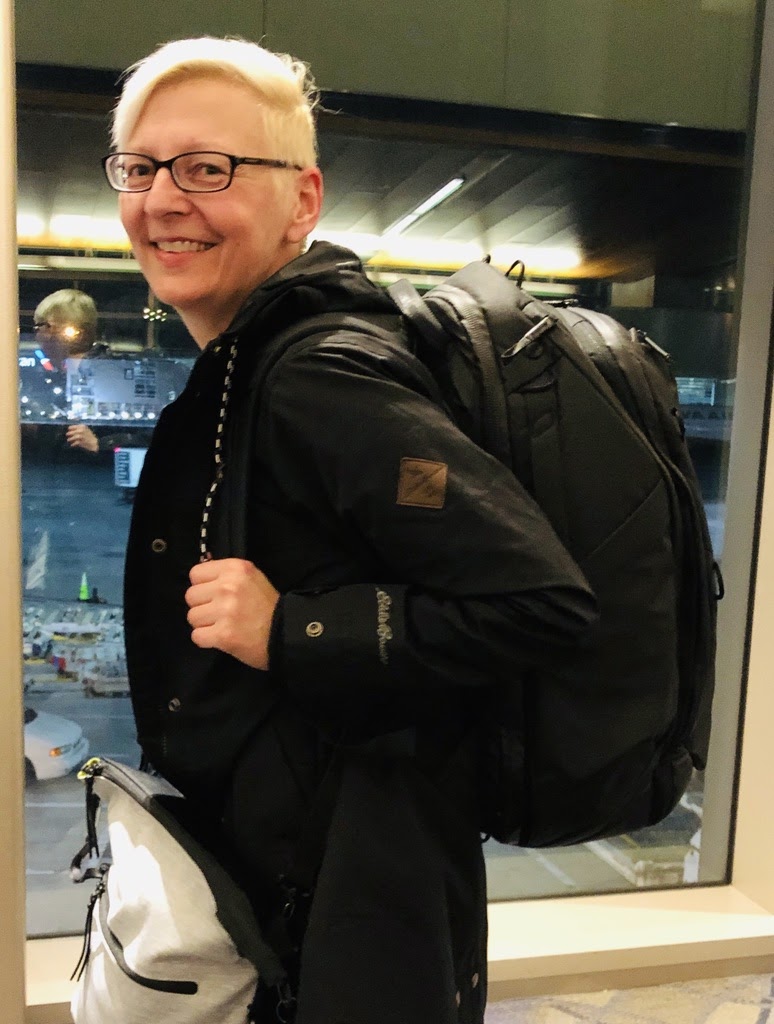
LAX, February 3: Looking forward to backpacking through Europe and the UK for 19 weeks.

Better times: In LAX, February 3, I was excited about backpacking through Europe and the UK for 19 weeks.

On March 14 I was five and a half weeks into a 19-week sabbatical trip backpacking around Europe. So far I’d visited Madrid, Alcalá de Henares, and Barcelona in Spain; Lisbon, Portugal; Marrakesh, Morocco; and Copenhagen, Denmark. Now I was headed to Granada, Spain. I’d bought my ticket to visit the Alhambra back in January; I’d be visiting it tomorrow, Sunday, March 15. And as for the rest of it? I wasn’t afraid of catching the novel coronavirus; I half expected I’d already had an asymptomatic case, given the amount of traveling I’d done already on trains, planes, buses, taxis, and subways. Besides, I was still (relatively) young and healthy, and this thing only affected the old, right? As long as I was careful, I’d be fine. I’d been anticipating this year-long sabbatical for ages. I’d given up my apartment for this trip. I’d even agreed to go on ¾ pay for two years in order to pay for the second semester of sabbatical! Dammit, this was my post-six-years-as-department-chair, post-cancer, post-revising-the-entire-faculty-governance-system reward, and no stupid superflu was going to stop me from enjoying it!

The guards X-raying luggage at the train station wore masks and gloves, and about a third of the people waiting for trains wore masks. Everybody was trying to stay spaced apart. None of the concessions were open. I read while I waited, glad of my scarf every time somebody in the station coughed, until my train was announced.

Virtually nobody was aboard the train; only two others sat in my coach, all of us rows apart. The train concessions were all closed, of course. I took a photo of the empty coach. It felt like a good setup for a horror movie scene … the kind of movie where the other two people in the coach and I would end up fighting together for our lives against monsters. As it turns out, the trip was eventless, and we never even exchanged a word.
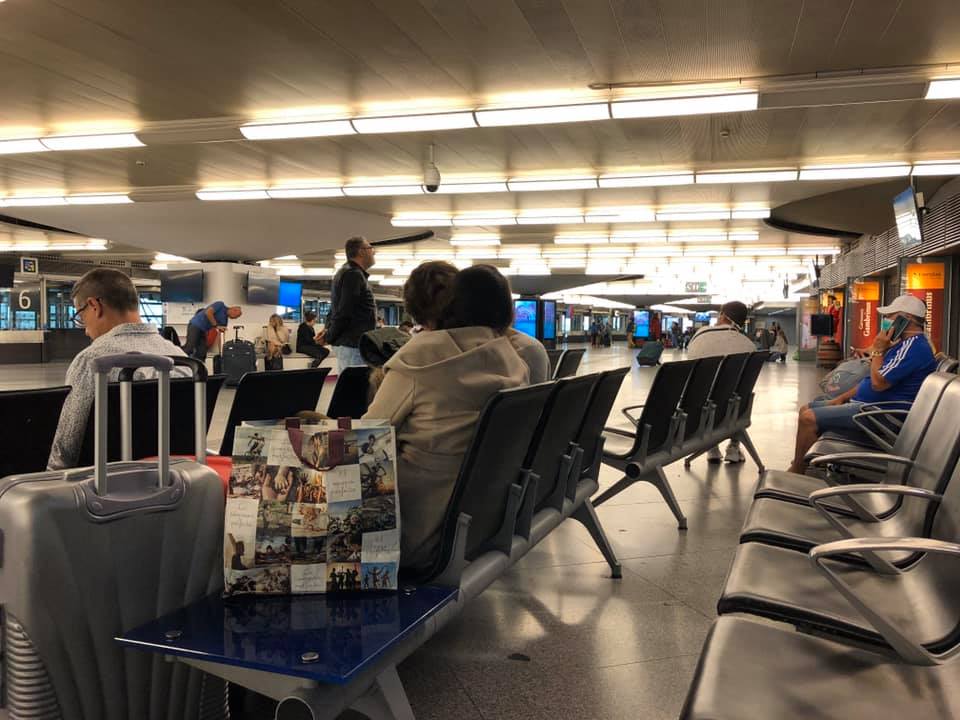
The Atocha train station wasn't crowded.

The Atocha train station wasn’t very crowded for a Saturday afternoon.

And neither was the train.

… and neither was the express train to Granada.


Granada’s train station was also surprisingly empty for a Saturday afternoon. I took a taxi from the train station to my rental and asked the driver, in my halting Spanish, how things were going in the city. Everything’s closed, I was informed; nobody’s here. The Alhambra? I asked. Yes, the Alhambra was closed. Restaurants. Stores. Everything. He looked disgusted. I was disappointed. I’d just visited a crowded Sagrada Família in Barcelona a week ago; how could the Alhambra be closed now?

My spirits rapidly sinking, I found my rental apartment; the grocery store right next to it was shuttered and dark. Too bad; that’s where I’d been planning to buy the night’s meal, since the restaurants in Spain were all closed. I’d brought some bread, cheese, and chorizo with me from Madrid, but that was all. I dropped off my backpack, confirmed that the landlord hadn’t left me anything in the fridge (sometimes they do, sometimes they don’t), and headed outside in search of sustenance. I found a small market a few blocks away that was still open, although the shelves had large gaps in them. I took a photo and posted it to Facebook: “It’s a little scary,” I admitted in my post, “and definitely not the sightseeing sabbatical I had been anticipating for so long….” Still, the market had cheap wine and enough vegetables and packaged food to cook up a pot of homemade soup. I took my groceries back to the apartment, wondering when and if the stores would be restocked soon. I was supposed to stay in Granada for four nights, then take the train to Cordoba and stay there for another two nights. Would the mosque in Cordoba be open? I’d already bought a ticket to see it, too. …Well, if I ate bread and cheese tonight and made soup tomorrow, I figured I probably wouldn’t starve, at least. That was something. Hopefully Cordoba’s stores would be open.

The market had been well picked-over.

The market in Granada had been well picked-over.
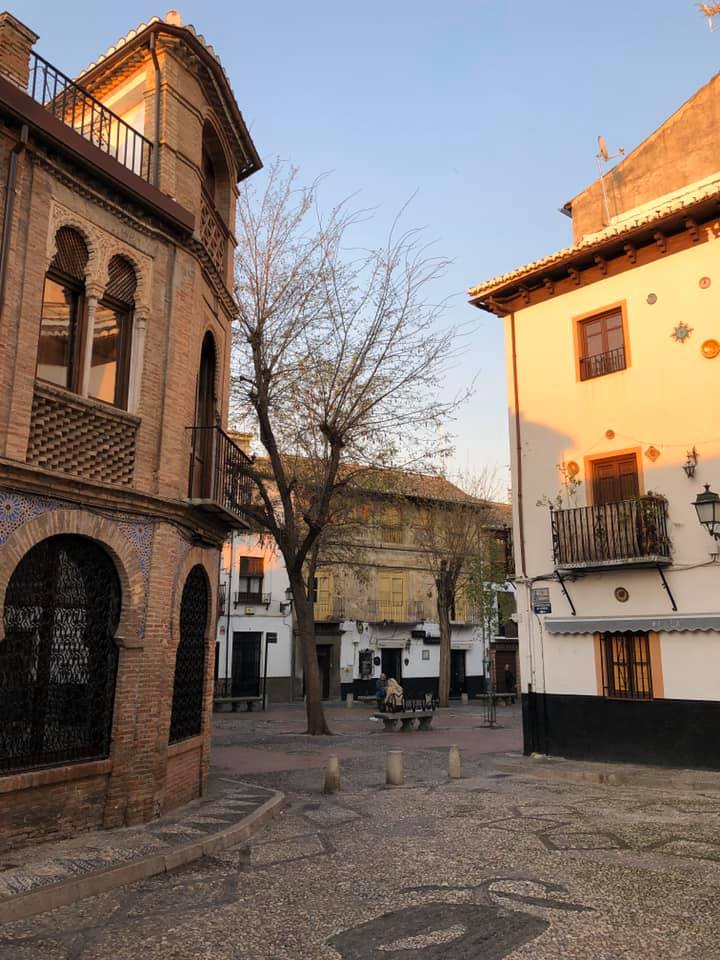
The plaza by my apartmentt was all but empty.

The plaza by my rental apartment was all but empty.
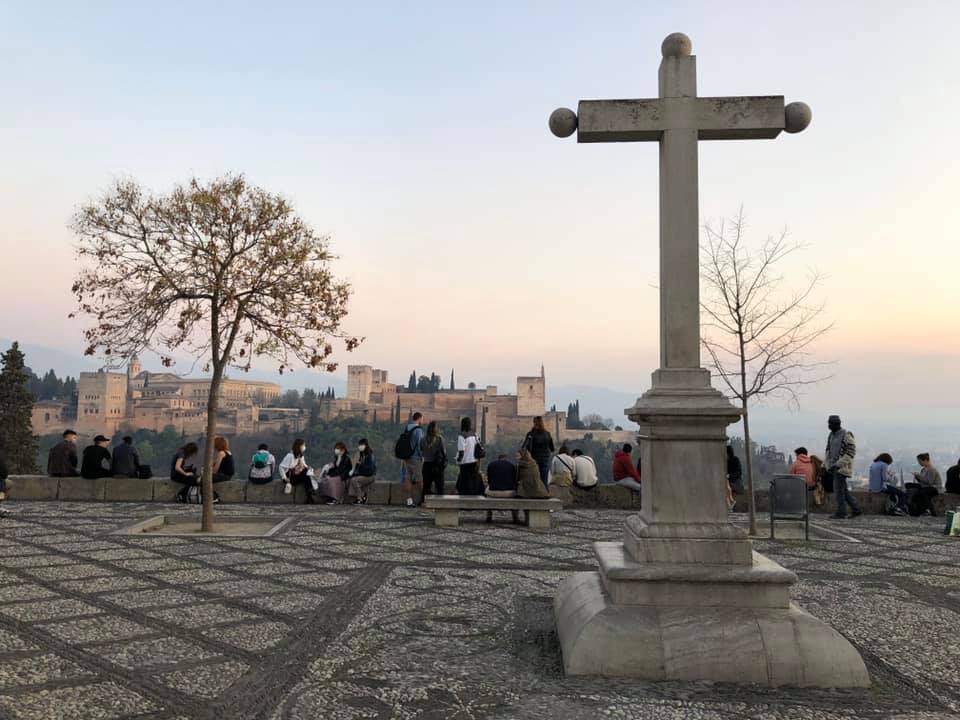
And surprisingly few people were out to watch the sunset turn the Alhambra crimson.

And surprisingly few people were out to watch the sunset turn the Alhambra crimson.


As the sun sank, I wandered aimlessly through the quiet, twisting medieval streets of Albaicín, the neighborhood I’d chosen to stay in. Everything was closed. At one plaza, from which I could see the Alhambra glowing in the sunset, a small crowd of twenty or thirty people had gathered, almost all of them young, taking selfies and chatting with each other. A sign of life at last — but nowhere near the crowds I was used to seeing on a Saturday night over the last few weeks. I walked back to the apartment feeling ill at ease. That night I cranked up the bedroom heat to ward off the chill I was feeling. I posted four photos to Facebook before going to sleep, titled “Ghost-town Granada.”
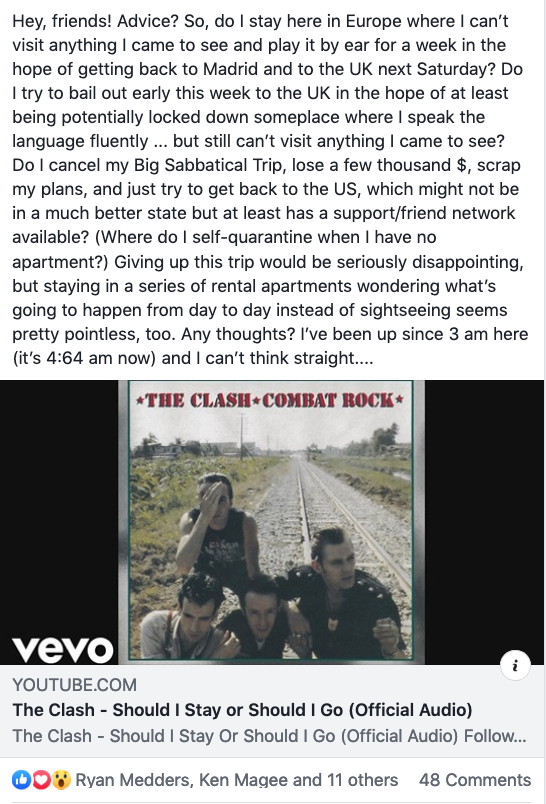
Screen Shot 2020-04-22 at 3.02.40 PMSunday, March 15, 2020, Granada, Spain: I slept restlessly and woke up around 3 am. In a bad habit that had been developing over the last week, I reached for my phone to read the latest news. It wasn’t good: Spain was about to impose a public transport lockdown to take place on Monday. I felt sick. Did I want to stay here in Granada and try to continue my trip as planned? Did I want to risk getting locked down in this old, labyrinthine neighborhood, where the stores were already stripped, and I knew nobody? I sent off stressed emails to family and around 4:30 am posted a video to Facebook of The Clash’s “Should I Stay or Should I Go,” asking my friends for advice. I received a flood of comments back. Some said stay in Spain, where the health care was socialized. Others said come back to the U.S. while I still could. I went outside and restlessly paced the empty, foggy streets in my neighborhood again, wondering what to do.

While I was walking outside, weighing my alternatives, an email came in from a friend in London — “You’re welcome to occupy the guest room as long as you need,” he wrote. After a flurry of WhatsApp and Facebook messages back and forth with him and his wife, I made my decision — I’d leave. I went back to the apartment, booked a same-day train ticket back to Madrid, and a next-day flight to London. I called but couldn’t switch my March 20 booking at the airport-adjacent hotel in Madrid because I’d made it through Expedia … and Expedia had been impossible to reach for days as it dealt with panicking travelers. However, “just come on in when you get to Madrid,” the hotel receptionist said, adding a touch dryly, “We have plenty of rooms right now.” I texted the apartment landlord: “I have decided that it’s better for me to take a train back to Madrid today,” I wrote. I apologized for leaving food in the refrigerator. “Ingredients are unopened and untouched […] if you or anyone you know could use the food during the quarantine.” The landlord wished me well: “I do understand and I don’t know what to say … Strange situation. Take care of your self….” I already knew there wouldn’t be a refund for the days I wasn’t there.
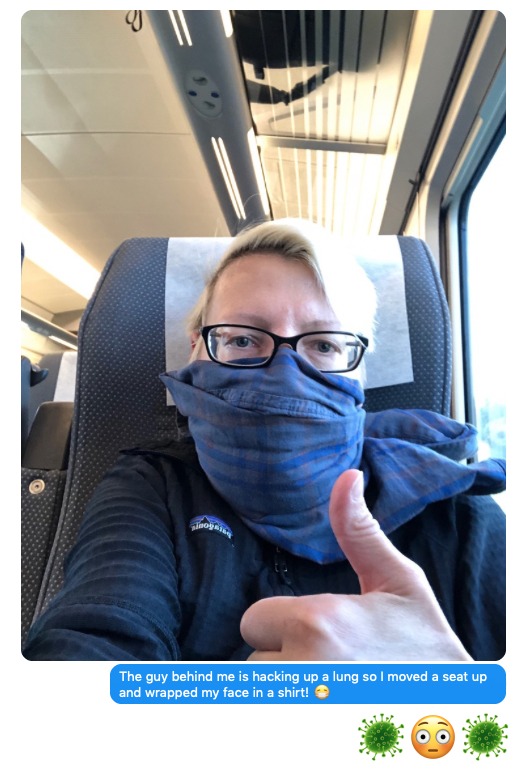
Texting to my sister on the train ride back to Madrid.

Texting to my sister on the train ride back to Madrid.

Not for the apartment in Granada, not for the apartment in Cordoba, and not for the two train tickets I wouldn’t be using.

Sunday’s express train back to Madrid contained a few more passengers than Saturday’s to Granada; people were still moving while they could, I assumed, before Spain’s stay-at-home order went into effect on Monday. In my panicked packing I’d shoved my scarf deep into my backpack, so I wrapped an extra shirt around my face instead, and when the passenger behind me started coughing, I quietly moved up a row to an empty seat.

A storm hung over Madrid, forming an almost too perfectly dramatic backdrop of flashing lightning and rolling thunder as I took a taxi to the hotel. Sure enough, there were plenty of rooms available. The hotel restaurant, like all restaurants in Spain, had been closed. Fortunately, I’d anticipated this and thrown some of the nonperishable groceries I’d bought the night before into an extra bag. Two-day-old bread, cheese, and chorizo was a spartan meal, but at least I had some dry cereal I could eat for breakfast, and one of those bottles of cheap wine I’d bought in Granada to help me go to sleep. Everything felt surreal.

Monday, March 16, 2020: Madrid, Spain & London, UK: Digital signs over the freeway to the Madrid airport reminded drivers that all non-essential travel was prohibited. Inside the nearly empty airport, regular announcements reminded us to stay two meters away from each other. I saw more people wearing masks now than I had before; maybe half of the travelers, and almost all of the airport employees. I was wearing one of the now-precious surgical masks I had picked up earlier in anticipation of my Saturday, March 21 flight to the UK. Well, today was only March 16, but it was clearly time to keep it on as I uneasily scooted away from other travelers and kept my eyes on the flight boards. A lot of flights had been canceled. Fortunately, my easyJet flight to London Gatwick wasn’t one of them.

Announcements at the airport insisted we remain two meters apart.
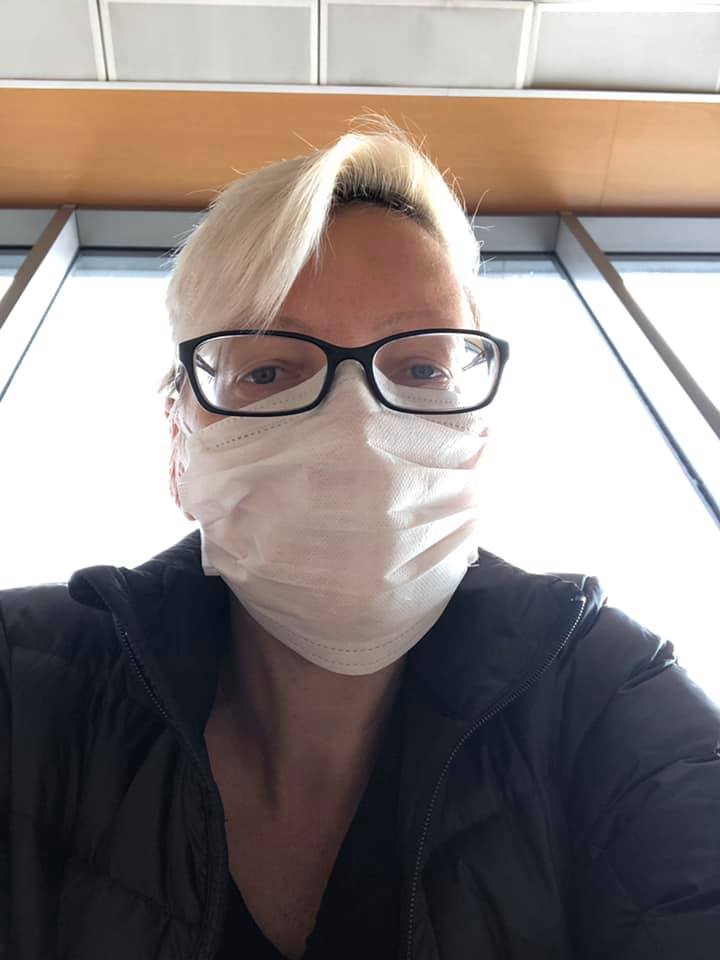
Announcements at the airport insisted we remain two meters apart.

I wore a real mask on the flight from Madrid to London.

I wore a real mask on the flight from Madrid to London.

London felt like a breath of fresh air; almost nobody I saw was wearing a mask, restaurants were open, and the trains and Underground were bustling. I abruptly realized how oppressed I’d been feeling in Spain — I’d experienced a sense of starkness, of grim apprehension, in Spain over the last day or two that hadn’t yet settled over the UK. I texted to my sister, “It feels much less tense here; fewer people wearing masks, stores open, etc!” I kept my mask on, though, as I worked my way via public transportation to my friends’ flat, cognizant of the fact that I could be carrying the virus from Madrid.

However my friends DB and DD decided to trust in my health and allow me to unmask in their apartment. I could stay, they assured me, until my rental was available — I was supposed to be taking over my London apartment on Sunday, March 22 and stay there for two weeks. It was a generous and, given the circumstances, brave gesture.

However, that night it became clear that London, too, was seriously considering imposing restrictions. I struggled with myself a while and then decided to book a ticket to the Tower of London for the next day, Tuesday. Visiting the Tower was at the very top of my London to-do list. My two friends agreed: I should go while I still could. None of us knew how long anything was going to stay open.

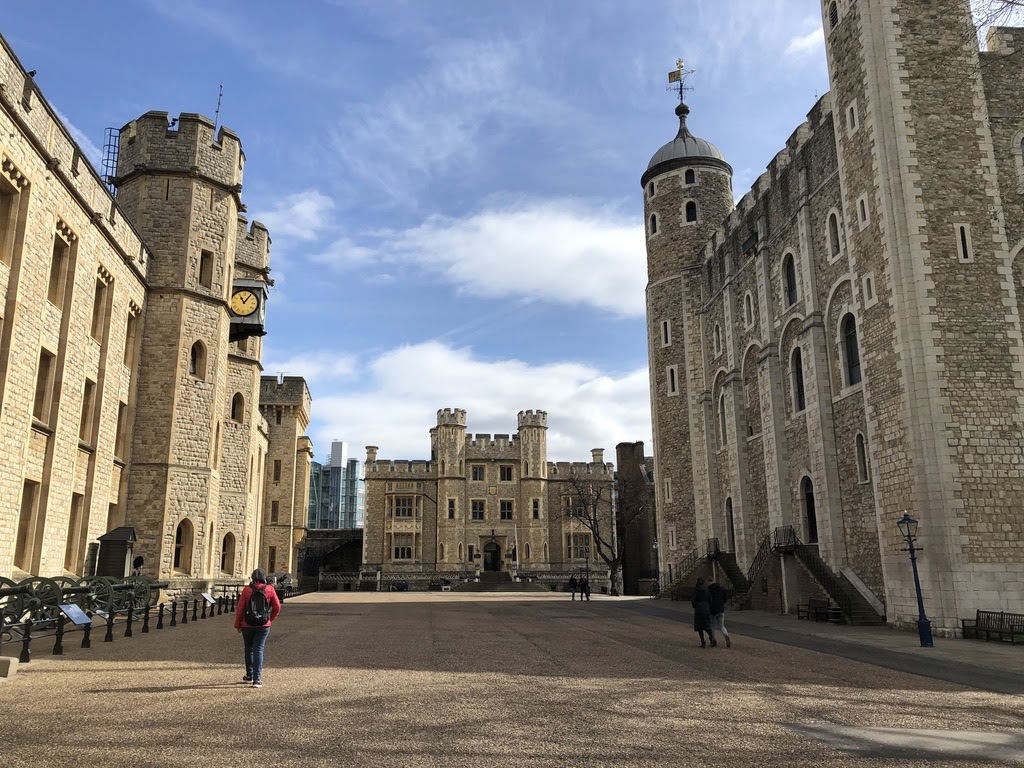
Tuesday, March 17, 2020: London: My visit to the Tower was incredible — very few people were there at all. I was able to take photos of nearly empty courtyards and buildings, and meander my way around the crown jewels twice, asking questions of the warden in the room. I continued to wear my mask, though, out of consideration for others in the Tower’s enclosed spaces. One or two other tourists were doing the same, but most weren’t, and the Tower staff and guards weren’t. When I finally tore myself away, I ate lunch — hooray, the restaurants were still open! — and was about to hop the Underground to go to the Museum of Natural History — my number-two goal for London sightseeing — when I happened to check its website for the closing hours. It had closed due to the coronavirus just one hour before, and it would remain closed until further notice.

I felt the walls shrinking around me again.
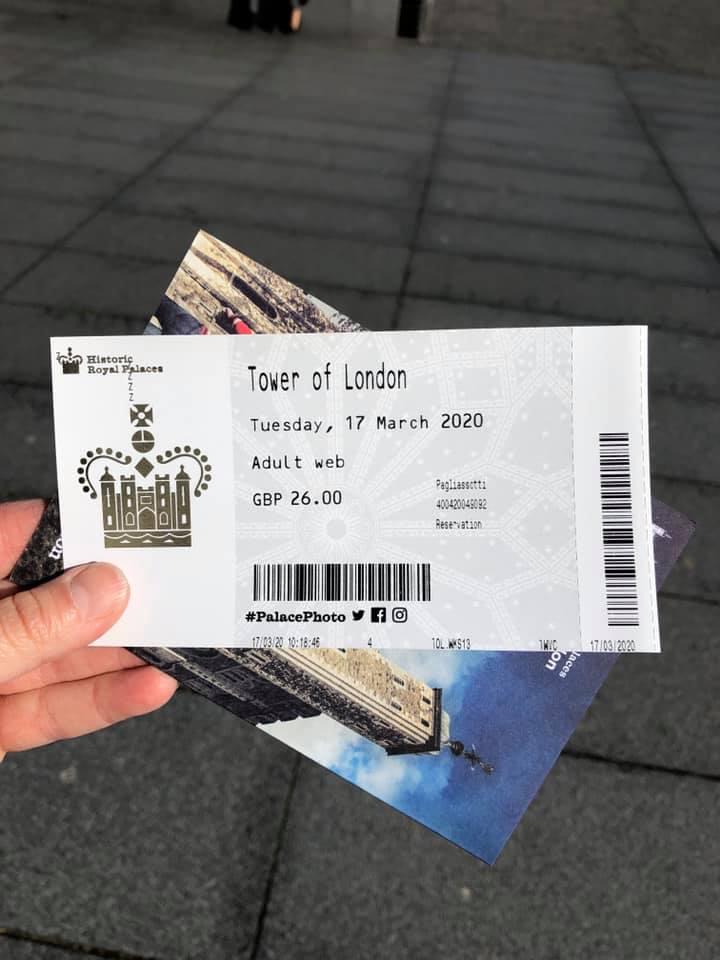
I was so happy to see the Tower at last!
I was so happy to see the Tower at last!

But almost nobody was there.
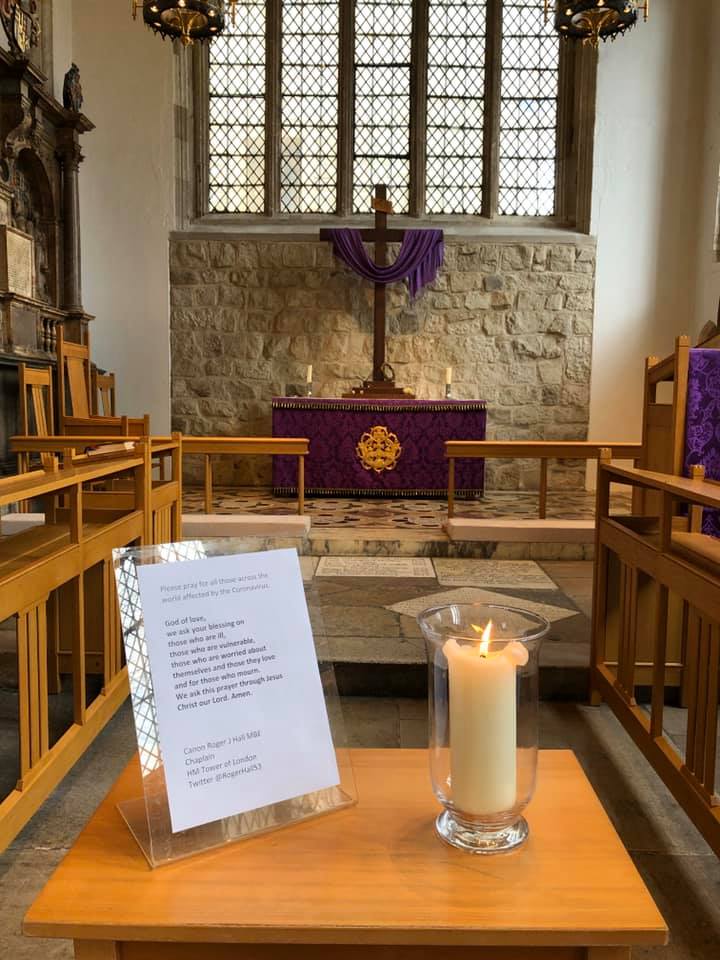
The chapel had a prayer: “Please pray for all those across the world affected by the Coronavirus. God of love, we ask your blessing on those who are ill, those who are vulnerable, those who are worried about themselves and those they love and for those who mourn. We ask this prayer through Jesus Christ our Lord. Amen. Canon Roger J Hall MBE, Chaplain, HM Tower of London, Twitter @RogerHall53”

The Tower chapel displayed this prayer: “Please pray for all those across the world affected by the Coronavirus. God of love, we ask your blessing on those who are ill, those who are vulnerable, those who are worried about themselves and those they love and for those who mourn. We ask this prayer through Jesus Christ our Lord. Amen. Canon Roger J Hall MBE, Chaplain, HM Tower of London, Twitter @RogerHall53”

Wednesday, March 18, 2020: London: This was the day I should have been taking a train from Granada to Cordoba. Instead, I sat in the spare bedroom of my friends’ flat in London, FaceTiming with a friend from the US and fruitlessly trying to connect with Expedia to see what money I might get back from all those prebought tickets for sights, trains, hotel rooms, and flights that I clearly wasn’t going to use. But all I did was lose more money racking up data charges on my phone. ($110 worth, as I later found out.) None of the museums in London were open, but the markets and stores were, so one of my London hosts and I walked around a bit and had a drink up in The Shard, looking down on the Thames, St Paul’s Cathedral, and the Tower  I’d visited the day before. I tried to encourage myself with the thought that I might be able to at least see the outside of the palaces, cathedrals, and museums I’d hoped to visit. And I was going to be in London for several weeks. Surely things would reopen soon….
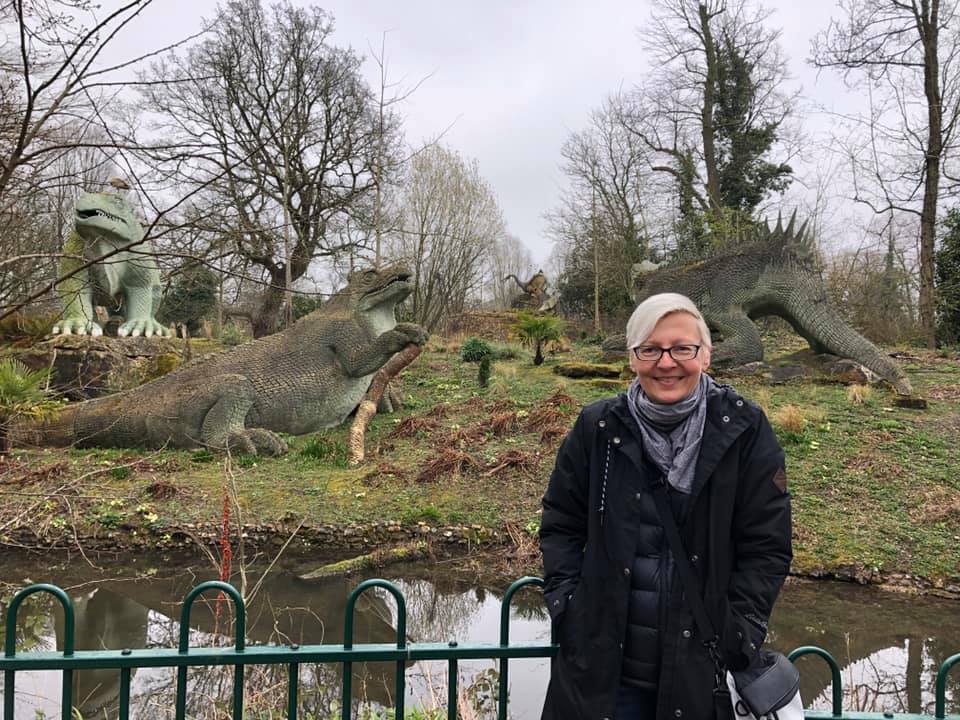
A stranger bravely risked the virus to take this photo for me.

A kind stranger bravely risked the virus to take this photo for me, with the Crystal Palace dinosaurs behind.

Thursday, March 19, 2020: London: I took the train out of London to Crystal Palace Park. Seeing the old, chunky Victorian Crystal Palace dinosaur statues had been somewhat lower on my London to-do list, but the park had the benefit of being open and the statues of being outside. The day was drizzly and cold, and I kept a scarf wrapped around my face on the train again. The park wasn’t very crowded, and everybody was keeping well-distanced. Still, after taking a handful of unsatisfactory selfies, I asked a young woman if she’d take a photo of me with one of the bigger dinosaurs behind me. “Do you trust me to touch your phone?” she asked with a half-smile. “If you trust me to have a clean phone,” I countered with a shrug. “I guess it’s a mutual risk.” She took my photo for me. I thanked her, gratefully. We both, I’m sure, surreptitiously wiped off our hands and hoped for the best.

I had tried to be optimistic the day before, but on this grey and dismal day I decided it was time to face reality. I was officially on the #worstsabbaticalever, and it didn’t look like things were going to get better any time soon. What was the point of traveling if I’d be stuck in an apartment because everything around me was closed? I knew I wasn’t going to get a refund on my London rental, but I could start canceling everything else and get most of my money back. Some of my train tickets and flights would be nonrefundable, but the rental units were the biggest expenditures, and I was still in the full-refund window for them. I talked to family and decided to try to stay in London — so I could recoup some of the money already spent on the rental! — but fly back to the U.S. on April 1 instead of April 4 … giving myself a few days’ wiggle room in case a flight got canceled and I needed to have a place to stay as I rebooked. Resigned to my fate, I booked a flight out of London to Los Angeles on April 1 and wrote on Facebook, “Hi, friends and family! FYI, I have undertaken the Great Dismantling of my sabbatical plans and am currently booked to return to the States on April 1 for my 14-day quarantine.”

Then the U.S. State Department issued a Level 4 Travel Advisory.

I immediately began receiving urgent texts and Facebook posts: Come home! Christina Sanchez, CLU’s watchful associate provost for Global Engagement, WhatsApped and emailed me: “I strongly recommend you attempt to get a flight back to the USA immediately,” she advised. My friends and family agreed.

Friday, March 20, 2020: London to Los Angeles: Thank heavens for 24-hour flight cancellation policies. Early Friday morning I canceled the April 1 flight and booked a same-day, nonstop flight to LAX on Virgin Atlantic. This is why I have an emergency fund, I reassured myself as I eyeballed the ticket price and thought about how much money I was already losing. And if bailing back to the U.S. in the middle of a global pandemic isn’t an emergency, what is? Still, I flinched as I hit the “purchase” button. I hastily crammed everything into my backpack once again, thanked my friends for so kindly allowing me to stay with them, and raced off to take the Underground to London Heathrow, wearing a fresh surgical mask for safety.

Emergency same-day flight in the midst of a raging global pandemic? Seems like a good time to upgrade and enjoy some free drinks.

Emergency same-day flight in the midst of a raging global pandemic? Seemed like a good time to upgrade my seat and enjoy some free prosecco before the flight.

At Heathrow, I had to pick up my ticket from the airline counter. “So, any deals on an upgrade?” I inquired, remembering my friends’ Facebook photos of their flight a week ago. “As a matter of fact…” I was told. At that point I’d already lost so much money on my sabbatical that a little more didn’t seem to matter anymore — and what the heck, the world was apparently ending, anyway. Might as well go out in style. I handed over my credit card for business class. Good choice, I realize in retrospect. I was able to sit, well-isolated and well-fed (and -prosecco’d), in a comfortable lounge with excellent hand-washing facilities until my flight, and then stay about as far away from other people as possible in an airplane. Pandemic privilege.
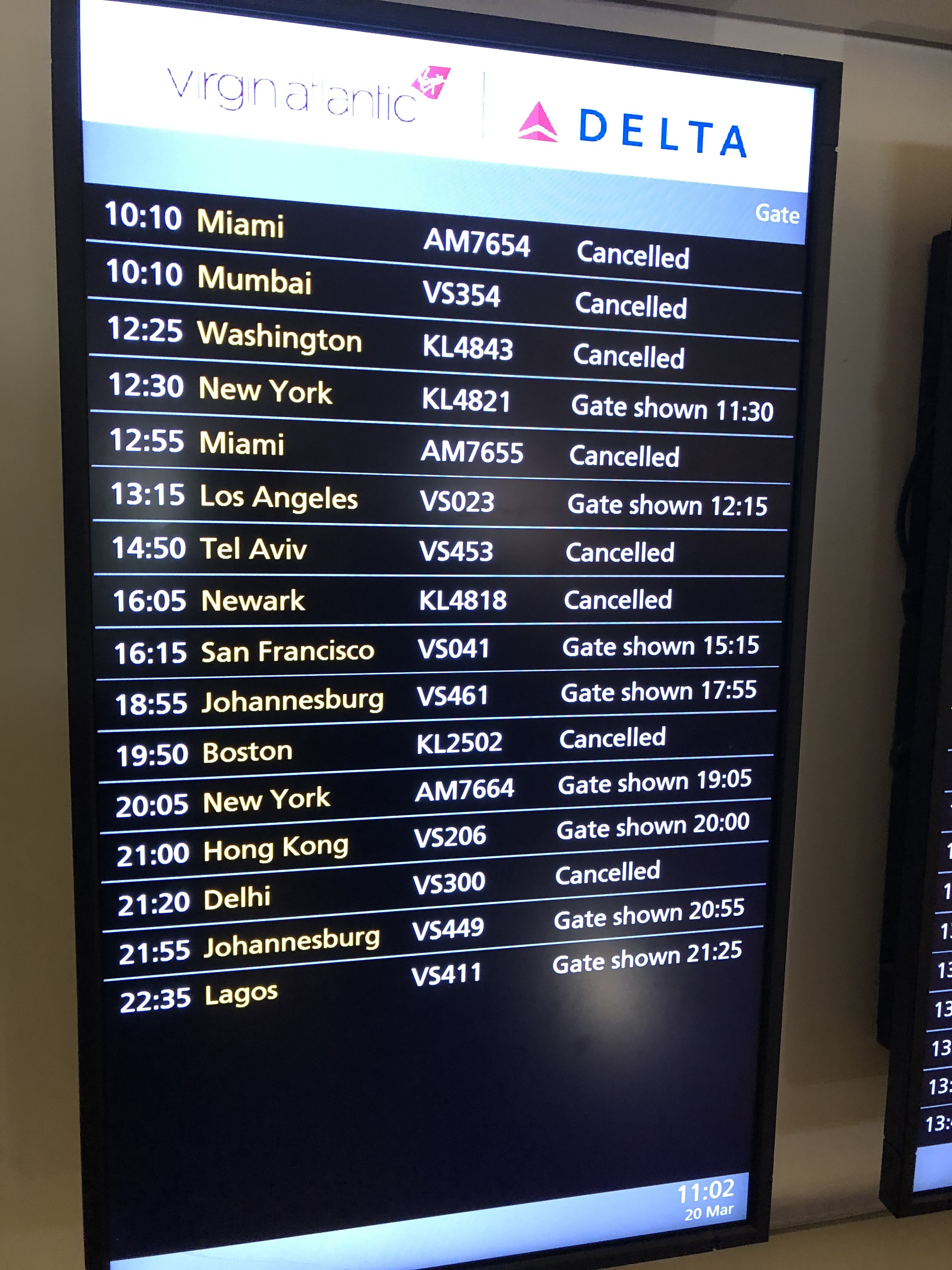
A lot of flights had been canceled. Fortunately, mine wasn't one of them.

A lot of flights had been canceled. Fortunately, mine wasn’t one of them.

It wasn’t exactly a relaxing flight, though, as I was frantically purchasing and burning through airplane data-use plans while trying to find a place to quarantine upon arrival back in the States and arrange to get back my pickup from the friends who’d been looking after it in my absence. The friend I’d been FaceTiming with on Wednesday had suggested that CLU might be willing to put me up in an empty dorm room, since most of the student body had been sent home. Although the university couldn’t, in fact, accommodate me on campus, Christina Sanchez came through like a champion, suggesting alternatives, and while I was still in-flight our provost Leanne Neilson generously agreed to have her office book and reimburse me for a local hotel quarantine stay. I immediately sent the information to my friends and family, relieved. I had a place to stay when I got back that wouldn’t endanger any of them!

My experience getting through LAX was much easier than that of my friends who’d returned in the midst of the chaos of March 13th and 14th. Business class exited the plane first, and I was one of the first to step out. Passengers were escorted one by one to the line of plastic-shielded, respirator-wearing employees in the airport passage who asked questions about where we’d been and whether we were showing any symptoms of illness. I answered, was given a card about COVID-19 symptoms, and waved onward. That was it? I wondered. Global Entry was a breeze, as always, and all I had was my backpack, so I was out of the airport in about fifteen minutes. It took me longer to wait for the airport circuit bus that would take me to the parking lot where all the taxis and airport shuttles were now located!

I didn’t have any problem finding a Prime Time driver to take me to Moorpark, where I was going to get my pickup and drive it to the hotel where I’d be quarantined — but he wanted to be paid $90 in cash. The credit card machines are down, I was told by all of the drivers in the row. Were they? I don’t know. But I was very glad that before I’d left the U.S. back in February, I’d tucked a few $100 bills in the back of my passport holder for an emergency. I certainly never imagined that emergency would be a global pandemic … I’d been thinking more about my credit card being denied somewhere … but nevertheless I had the cash, so we were on our way.
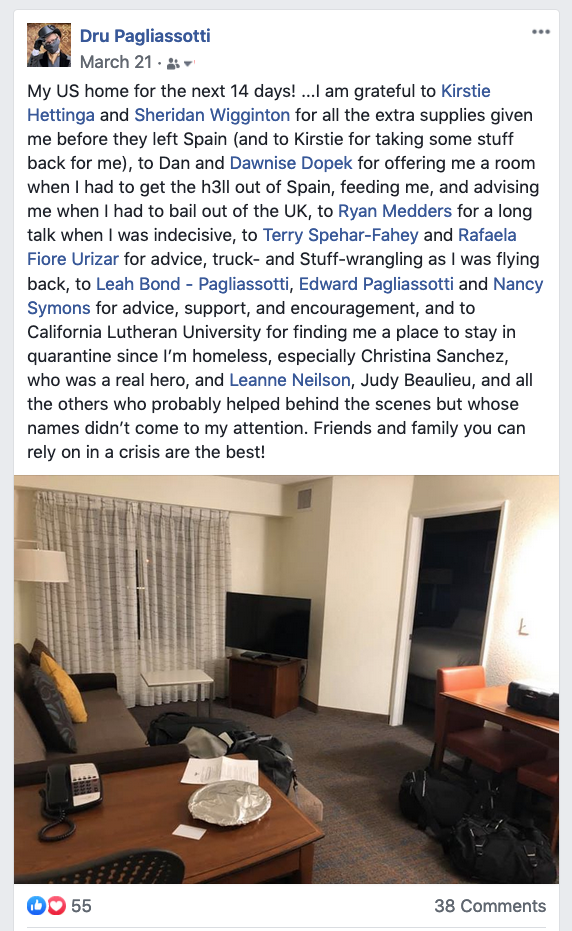
Screen Shot 2020-04-22 at 3.49.44 PMMy 14 days in quarantine passed without any fevers or other signs of sickness, and I’m now ensconced with two more friends in Moorpark. I may be staying with them for quite some time, depending on how long this pandemic goes on and how badly the economy tanks. I’m very grateful for all of the generosity people have shown me as I bounced from place to place like a pinball for a week or two: the spare rooms, the advice, the hotel quarantine, the grocery runs, the encouragement, and everything else.

In many ways the experience of hurriedly leaving Europe and returning to the US in the midst of a pandemic reminds me of my experience with cancer back in 2015. Then, too, I had to make panicked decisions and often felt paralyzed by stress and uncertainty … and then too I was taken aback by the generosity and patience of the friends, family, and colleagues who helped me through surgery, chemotherapy, radiation, and physical therapy. During cancer treatment I learned to face my uncertain future with equanimity, accepting that the most I could do was to enjoy as much of each day as possible. I’m trying to maintain the same mindset now. I’ve been extremely lucky so far, and I can only hope that five years from now I’ll look back on this pandemic the way I currently look back on cancer — as a terrible time in my life that, nevertheless, affirmed the important things in life: family, friends, and taking a moment to appreciate each new day.

Good luck. Stay safe.

https://www.tor.com/2017/12/06/debuting-at-forty-two-or-how-i-learned-to-stop-worrying-and-love-the-writing-process/

“Life has a way of getting away from you. You’re always going to really get going on it next year. Next year I’ll write a novel worth publishing. Next year I’ll start researching publishers again. Hey…I hear publishers are starting to put their information online now. Look how easy that makes it! I can start trying again. But I have to get going on this Ph.D. thesis too. Maybe next year.”

I sympathize with this essay a lot. I expected to be getting published a lot earlier than I did. And in my case, that Ph.D. thesis really did stop me from writing anything commercial for years (I wrote some stories for my gamer friends, though). It wasn’t until I was about ready to go up for associate professor that I was able to think about sending stories out.

Gestern Keep

Jan_van_der_Straet_-_An_Alchemist's_Laboratory_-_WGA21869This one’s a back-drawer novel. I’ve sent it out to two friends in my outside writing group, asking them if they think it’s worth revising, and if so, to get their advice. It’s set in 1520 in a tiny fictional realm between the Venetian Republic and the Habsburg Dominions. Fourteen-year-old Basti — Sebastiano da Napoli — has arrived at Gestern Keep, a remote mountain keep, to apprentice to a sculptor whose work he’s admired. The people gathered in the keep for the winter are a motley crew — The scholar-alchemists Lord Johannes and Lady Elisabeth and their son Dietrich, their reluctantly-on-the-marriage-market daughter Caterina, their ageless apprentice Araciel, the hard-drinking Venetian sculptor Danti, the mute flautist Hubert, the dwarfed and snarky visiting scholar Alrune (Danish for mandragora), and the grimly resigned cook Albrecht … and the ancient hunting god that haunts the keep, the Erlkönig. I did a ton of historical and cultural research while I was writing it, and read lots of books of ceremonial magic and angelology … I even wrote a religion professor to ask if early Christian belief could accept that a fallen angel could repent! (He said he thought so.) Anyway, the novel is about an ancient Teutonic god — the Erl KingTeiwa, Tîwaz — trying to wrest his land back from a divided Christianity; about repentant fallen angels and mysterious cursed heirs, tragic lycanthropes and medieval magic, and redemption and the power of symbols. IMO it all gets rather muddled and confusing, sometimes too erudite and sometimes too surreal, and far more Roman Catholic than I’m entirely comfortable with, so I don’t know if it’s worth trying to fix or not. Hopefully my writing group readers will be able to give me a good objective opinion; I told them I have no emotional investment in this anymore, so they can feel free to shred it as much as they want.

…In this scene, Basti, Caterina and Araciel are trying to get the help of the village priest, Father Völker, as they’re being pursued by the Erl King and his wolf pack. Basti has just learned that Araciel, whom he’d considered a friend, is actually a devil — a fallen angel, summoned by Johannes and Elisabeth to help them in their alchemical research and given in return a chance to seek a redemption on Earth that he couldn’t possibly hope to earn in Hell.

Caterina’s cry, faint over the storm, warned him in time to see something black and heavy hurtle toward him from the trees.

Basti raised his arms up to shield his chest and face, unable to do anything more.  The impact knocked him down, and snow flew up around him and the wolf that snarled over his chest. Sharp teeth ripped through the heavy fabric that protected his arms; amber eyes gleamed in the lantern light. Basti couldn’t draw a breath to cry out. He was paralyzed with terror as the beast’s teeth ripped closer to his flesh. Memories of the first time he’d been attacked flashed through his mind and he made a small sound in his throat.  Then, as though that sound had broken his paralysis, he felt a surge of anger. His whimper turned into a low growl of defiance.

Above him, a leather-gloved hand clamped down on the wolf’s scruff. Basti felt the wolf yanked from his chest, and his anger seemed to be plucked from him as neatly as the wolf. He scrambled backward, still seated, until Caterina grabbed his arm and pulled him upright. Unnerved, Basti staggered against her, still backpedaling.

Before him, the wolf squirmed and snapped in an attempt to clamp its jaws around Araciel’s wrist.  The apprentice grit his teeth and lifted his other hand, clutching his sword.  Too close to his foe to use the steel blade, he slammed the saber’s pommel into the wolf’s skull. Steel met flesh with a dull thud.

Managgia!” Basti exclaimed, forgetting Caterina’s presence. He remembered the devil’s iron grip when he’d awoken from his drugged unconsciousness, and now his last doubts about Araciel’s supernatural nature vanished. The devil lifted the sword again, straining to keep a grip on the writhing wolf as he slammed the pommel into the side of its head once more.  Blood spattered, creating a black webwork on his pale dueling gloves. The wolf yelped in pain, and howls sounded from the forest around them, drawing closer.

“Come on!” Caterina yelled, grabbing his arm. “We have to get to safety!”

Basti hesitated, then let her pull him away, keeping his head turned as he tried to keep track of his friend. She was right. Neither of them could help Araciel. The devil was the only one of them who had any chance at all against the beasts.

They took the lantern with them.

Darkness shrouded the two combatants.

Another sound rose over the wolves’ song; a long, clear note, the call of a hunter’s horn. Fear slid through his gut as Basti realized they weren’t just running away from storm‑maddened wolves.

They were running away from the Erl King’s hunting pack.

“Araciel, run!” Basti shouted, then turned as Caterina yanked him up the church’s steps. His feet slipped on snow-covered stone as he scrambled.  Caterina set the lantern on the stair as Basti fought to turn the handle of the heavy wooden church door.  She risked a glance over her shoulder, and stiffened.

“No!” she gasped.  He turned, his eyes widening.

Araciel had stopped when he’d seen his young friends safely on the church’s steps. Now the pack was on him, the wolves’ eyes shining in the lamplight from the church. He lifted his saber in solemn salute between their glowing eyes and himself.

Basti froze, watching, as the fallen angel spoke a word in a language he’d never heard before.

The power of the word shook the wind and the earth around them.  The wolves paused a moment, then shook themselves and lunged.

This ends up becoming one of the key scenes in the novel for Araciel, when he ends up being tackled into the church by one of the werewolves — while the werewolf is immediately turned back into its mortal form, Araciel remains unharmed, which he sees as a sign that he’s been forgiven.

You may notice the moment where Basti suddenly feels a surge of anger and growls back at the attacking wolf? Yeah, the novel starts out with him having been bitten by a wolf before arriving at the keep. He’ll be running on all fours before the novel is out.

Anyway, I look forward to hearing what the others think. We’ve tentatively planned to meet for coffee on the 15th, which will be Friday of finals week. One of them completed NaNoWriMo last month, and I’m kinda expecting her to send me her MS in return for critique, although I haven’t seen it in the gmailbox yet.

(Image Credit: Jan van der Straet, “An Alchemist’s Laboratory,” 1570)

Short Fiction

OK, this is pretty macabre stuff, but … Larkin’s 6-word stories reminded me that I’ve written a few very short stories, myself. Not 6-words, but … short. They are, if you like, companion pieces to my novel An Agreement with Hell, which is set in California Hills University. I pulled them out of the now-Word-incompatible archives, blew the dust off of them, tweaked a word here and there and ….

… brace yourself. Here we go:

*******************************

California Hills University: FRESHMAN ORIENTATION

Katie Ericksson sighed as the small freshman class marched to the spirit rock overlooking campus.

She’d arrived two days ago, and she already knew she was never going to fit in. California Hills University was attached to the same synod she’d attended in Wisconsin, but Southern Californians were very different from Midwesterners. Katie felt like a stranger. She’d called home, crying from homesickness, but her parents had insisted she give the place a chance.

Coarse grass crunched underfoot and the dusy scents of sage and pinon filled the air. Stars glittered overhead. Katie knew she should be filled with awe at the ritual, but she just felt miserably out of place and alone.

When they reached the summit, they circled the boulder. Forty students were in the freshman class; Cal Hill’s small size was one of the reasons Katie had chosen it. Now she studied the spirit rock to avoid looking at her peers. The boulder was covered with faded, peeling paint from last year’s class. Student government officers in matching ASCHU t-shirts waited next to the rock, paintbrushes and cans at their feet.

“Each year the freshman class of California Hills University convenes here at midnight on the first day of classes to raise the school spirit,” intoned the student body president, stepping forward. “By painting this rock we make our mark on the university, a mark that will remain no matter how many more come after us, no matter where we go after graduation.”

The officers began handing out paintbrushes.

“Each year one freshman is elected by his or her peers to represent the class at this event. This year, Katie Ericksson has been selected for the honor.” The student body president turned to Katie and smiled. “Katie, come forward.”

Katie looked around, wide-eyed. Her roommates gave her wide smiles and encouraging nods, and the other freshmen all beamed at her.

“But, but nobody knows me,” she stammered.

“At a university this small, we all know each other.” The president reached out and clasped her hand, leading her to the rock. “Katie, school spirit is important at Cal Hills. Your classmates know you’ve been homesick, and they want to assure you that you have a place in their hearts.”

Katie smiled shyly as she sat down.

“Thank you,” she whispered.

The ASCHU officers pried open the paint cans. One can, clean and empty, was passed forward and placed next to her.

“As the representative of this year’s freshman class, you embody its heart and soul,” the ASCHU president intoned, taking the long knife one of her fellow officers was holding. California Hills University was engraved in gold script along its blade. “Tonight, Katie, you become part of Cal Hills forever.”

Her peers applauded as Katie proudly lifted her chin.


*******************************

California Hills University: SPIRIT STICK

Every year some prankster always decides to steal California Hills University’s spirit stick.

“So, this is what all the dorms are competing for?” Greg cast a scornful look at the five-foot pole, covered with bands of hard, cracked rawhide. “What a crock.”

The leather spun away from the stick like tentacles.  Greg didn’t have time to scream before he became the newest layer.

The Student Life representative who finally found the spirit stick put it back into its glass display case with a resigned shake of her head. What could you do? All the students had been warned in Orientation that CHU valued a strong school spirit.


*******************************

California Hills University: CAPITAL CAMPAIGN

Vice President of Marketing Reginald Onesvald leaned forward. Arne Thorvald had been a significant donor to California Hills University for over twenty years.  He’d been awarded an honorary doctorate five years ago, when his health had begun to fade.  Now Thorvald was on his deathbed, and Onesvald had one last offer.

“How many have signed up for this campaign?” Thorvald asked, sounding uncertain.

“We already have twenty donors from your class, sir, and more are coming in. Next year we’ll open the Patron-in-Residence program to the rest of Cal Hill’s alumni, but your class, the very first in our school’s history, holds a special place of honor in our hearts.”

Thorvald smiled weakly.  “Where would I be?”

“Sir, in recognition of your many contributions over the years, we’ll put your marker right in front of the theater door, where everyone will see it every time they attend one of the student productions your endowments have made possible.”  Onesvald pulled out glossy photographs.  “As you can see, we offer three different marker shapes, all bearing the university seal.  In addition to your name and the relevant dates, you can include a personalized message of up to 10 words.”

Thorvald nodded, and Onesvald quickly slid the papework beneath his hand.

“What about the interment?” Thorvald asked, picking up a pen.

“The university has made special arrangements with the county to offer three options to prospective patrons-in-residence.  The first is the classic vault option, interring you in the university walls.  The second is what we call the alma mater option, using a biodegradable casket to make you part of our award-winning landscape. The third option is cremation, with a wider range of residence options.”

“Classic vault is fine.”  Thorvald began checking boxes, his hand trembling slightly from illness.  Onesvald looked over his shoulder. The university’s capital campaign had just reached its $40 million mark. He beamed.

“Thank you, sir. You will never regret becoming an eternal patron of California Hills University.”

***********************************************************************************************


I began poking around at some of my long-neglected folders of story fragments and finished but not inspired works. Some of the files were so old that Word couldn’t open them anymore; I had to open them in TextEdit, copy out the text, and paste them into new Word documents. The process led me to re-read them, sometimes changing a word here or there. Most are just “eh.” I was amused to find one document contained about five different introductions to the same character, as if I’d been trying out approaches looking for the right one. But I found a few stories that are probably worth the effort to revise, although I haven’t worked on a story for years. Lately, it’s all been novels.

One story is basically finished and called “Fellgate,” 5,244 words of blood-soaked fantasy adventure more notable for its gritty voice and slaughterhouse monsters than for any great plot. It starts,

I was deep-throating a voltaic rod. The copper plating tasted bitter and the metal tip clicked against my back teeth as I dry-swallowed. My hands kept twitching forward to cover my groin, like my subconscious was thinking, “well, the big head’s a goner; better keep the little head safe.”

It’s the kind of story where everyone’s essentially bad, although the narrator is just a shade more moral than the people around him. It’s a simple story with a “bonk” plot, but I’m still fond of it, so maybe I can do something with it.

…Another story needs a lot of rewriting, but the concept still amuses me. Its working title is “Mage Hunter.” The opening, which is totally clunky and needs to be tightened, goes:

“You are either the bravest man in the world, or the most stupid,” said Xavier Planck with amazement as he stared at the stocky clerk who stood before him.

“Yes, sir.” Armino refolded his warrant, thick with royal seals and ribbons, and slipped it back into his heavy courier’s bag. He pulled out another sheet, covered with his own cramped handwriting but signed by a clerk of the civic exchequer as witness to its accuracy. “According to Avomar’s tax rolls, you have not paid your metoikion, capitatio, or window levy for the last three years. Including 2.7 percent interest accrual for each year the sum is in arrears, you owe the duke of Avomar 125 aurei, 23 denarii, 7 duponidii, or the equivalent in civic service, that equivalency to be determined by the court of the exchequer and you or your chosen advocate.”

I believe I’d been reading about medieval to early modern tax structures at the time, for some obscure reason, and I wondered why fantasy so seldom deals with taxes.I figured the bravest man in the world would have to be the tax collector who goes after all the great wizards and epic villains who you just KNOW never pay into the royal coffers of the lands in which they live. He’s the “mage hunter” of the title, the fearless tax-policy wonk bounty hunter who goes after the most powerful people in the land for a percentage of whatever taxes he’s able to collect from them. The story is fairly simple right now — he goes after a villain who tries to kill him, and as they fight he keeps finding new monstrous constructions that require more tax payments or civic violations that need to be fined, spieling them off during the combat. What I don’t have is a particularly catchy end. I suppose he needs to defeat the villain, get the signature on his forms, and then maybe sit down and fine himself for whatever damage he caused in the fight, or something equally silly.

A third story probably needs to be a novel, but I’m not sure where I’d take the plot. Working title “Ruined.”

Lady Elsepeth Britton strode into the room and sank into a low curtsey before the man inside could say anything.

“I understand you are willing to pay a great deal to ruin a woman,” she said, gazing down at the exotic pattern woven into the imported carpet.  “I would like to know how much you are offering, my lord.”

A moment’s silence answered her opening sally, and then she heard Conte Sorvegliante sink back down into his armchair with a rustle of silk and velvet. She stole a glance upward, just enough to see him cross his legs. His diamond shoe buckles glittered in the afternoon light that stole through the drawing room windows.

Basically the foreign count has a dreadful reputation and Lady Britton’s family is in debt, so she’s decided to sell her virginity to him to save them. So far, so cliched, right? So a few paragraphs down:

Elspeth sat in silence, then shivered and lifted her chin.

“Will you be purchasing my obedience, or my life?”

He gave her a quizzical look.

“What do you mean?”

This time she couldn’t stop from curling her hands into fists.

“Would this agreement permit you to hurt me? Beat me? Kill me? Steal my soul?”

“Really, my lady.” His tone was reproachful.  “We’re speaking of ruination, not destruction. I will most certainly make you work to pay off your father’s debt, and not all of what I ask of you may be to your taste. But what use is a possession that you intend to destroy? After our three years are over, you’ll still be alive and in good health and, perhaps, somewhat improved.”  His smile was crooked and didn’t reveal his teeth. “We are only discussing servitude, after all. I am not purchasing either a slave or a wife.”

As it turns out, though, the way the count intends to abuse her innocence is by requiring her to read social and political tracts that she would never have otherwise thought to touch. She finds the ideas in them unpleasant but eye-opening. Thus, while everyone assumes they’re in an illicit sexual relationship, she’s slowly being drawn into his odd, quasi-libertarian philosophy about possessions, ownership, and contracts. So she is ruined as a member of the aristocracy but ends up a social reformer.

“If our slavers are poaching in your land, it’s a matter for the ambassador.”

“The ambassador is doing all he can.” The count bared his teeth in a strangely predatory snarl.  “And I can do nothing.”

“You can purchase them.”

“Your law doesn’t permit me.”

“Then give me the money, and I will purchase them.”

He looked at her sharply.

“I will spend your money, so they will be yours, of course. Isn’t that what you want?” she pressed.

“Yes….” the word was almost a hiss, and his eyes didn’t waver from her face.  “But for you to act as my proxy is … of suspect legality.”

She shrugged.

“What can the authorities do to me that I haven’t done to myself already?  Give me your money, my lord. Nobody will think twice about it, under the circumstances.  I’ll buy the slaves and have them housed — where? Your mansion?”

“That would be acceptable.”

“You still look dismayed, Lord Sarcany.”

“I do not approve of paying for that which is already mine. And I dislike putting my money into the hands of slavers. A man’s body and mind are his own possessions. He may choose to sell them or give them away as he will, but to have them forcibly taken and sold is an abomination.”  His face was hard. “Your country’s obsession with commerce has made it rich, but it’s also made it corrupt.

“A man’s, but not a woman’s?” Elspeth asked, sharply. Lord Sarcany raised an eyebrow, as if surprised by the correction.

“Both. Did I not respect your right to sell your body and mind?”

As it turns out, the Conte is a (shapechanged) dragon, and his whole philosophy is based around a dragon’s strong sense of the right of possession. These are the two things I like most about the story — twisting the (expected) pornotopia myth of “ruin” as a form of sexual awakening into “ruin” as a form of social awakening and figuring out what a dragon’s moral and social philosophy might be like in an early 19th-century sort of setting. I also like playing with the tropes of the Regency romance, of course. But all I have is a beginning and then a series of disjointed scenes, which totally does not work for me as a writer; I have found that I must write straight through in order to finish a work. So I need to puzzle over how I might turn this into a proper short novel without it becoming too dull or preachy or predictable.

None of this is getting me closer to finishing Right of Rule, of course, but at least it’s a good reminder that I have plenty of other writing projects I could pursue.

Dream Interlude

In my dream a few minutes ago I was arguing furiously with some kind of guy in a white suit or uniform, advancing on him and driving him backward, to tell me how to escape from the video on the giant screen in front of us because if I let it run through there would be dire consequences for all of us — something to do with racist messages that would inflame the audience, which was everyone on the street milling around us. He looked up at the reflective windows of the tall bank building on the street behind us and protested, “there is no screen.” I was furious at him for not realizing we were just watching a video and I began Googling to try to find the creator’s name, which was something like Israfahanim….

I woke up to my alarm with that dazed, interrupted-REM feeling, and I immediately thought (with somewhat less clarity than this), “It’s  a Buddhist lesson. You were so furious in your dream, reacting to your own mind’s stories. You should think about how often in daily life you react to something that’s all in your mind…” Then I wondered who Israfahanim was and could only think of the angel Israfel, whom I vaguely thought had something to do with death. I was deeply into angelology at one point in my life; the scraps of my research still linger.

After I stumbled out of bed and put on some tea I looked up variations on Israfahanim to see if it was a real name. Nope. But Israfel sounds the trumpet on the Day of Judgement, which has the same kind of apocalyptic feel that I had in my dream — that disaster was imminent.

They say dreams are just the brain clearing itself up, and I can easily track the strands of this dream in the variety of technothrillers I’ve been reading lately and my general fascination with questions of reality and perception, teaching film, reading the news each morning, kempo emphasizing that I must “get into your opponent’s space”, and perhaps the white suit as a symbol of God or a doctor or an insane asylum employee or something, who knows! But I think my groggy takeaway was the important point; the Buddhist understanding snapping in. I wanted to stop the false reality of the giant VR video while not realizing that I was, myself, just part of a dream. Most of my emotional reactions arise due to thoughts in my head about what I see or read or imagine, rather than from any real physical or verbal interaction. I need to wake up from my dream world and simply address reality as I live it, moment to moment.

Waking up in the Buddhist sense of the term is easier said than done. But I appreciate the reminder, even if it meant jolting out of sleep with my heart pounding, feeling unrested.

Gaslight Day 2

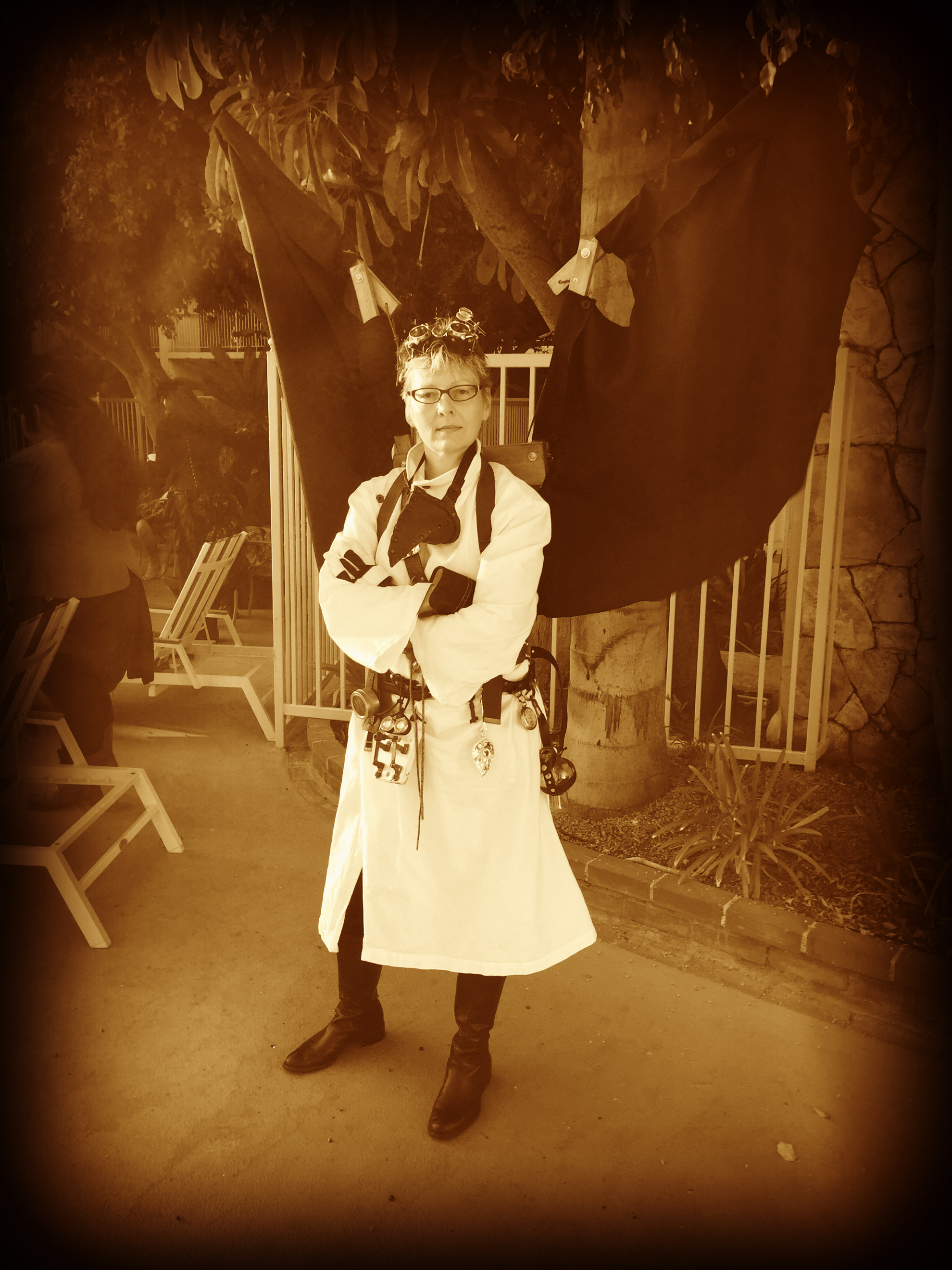
madscientist…And here’s Dr. Calamity, Aerial Support: Mad Scientists Without Borders. “Need a disaster? We’re there for you!”

Yeah, this is what I do in my spare time. Actually, I started the mad scientist costume as Dr. Horrible cosplay at Bent-Con in Burbank. At the time I was writing a chapter on female mad scientists in webcomics for an academic book on Neo-Victorian Humour. I presented a summary of my work as a panel at Gaslight last year, so I steampunked the Dr. Horrible costume up a bit for the presentation. This year it kinda got out of hand….

That said, there’s a reasonable chance I’m going to expand that work into a scholarly pop-culture book as my sabbatical project.

Today I sat on another panel with the same authors plus one (Eric Hendrix, who wrote the graphic novel The Steam Engines of Oz), where we talked about fantasy vs. science as themes in steampunk literature. It’s fun chatting with authors. I caught Tim Powers as he was leaving the con and thanked him for writing Dinner at Deviant’s Palace, one of my favorites. He said “thank you” and shook my hand, which was interesting, because we hadn’t shaken hands on the two panels we’d been on together! Every writer loves a compliment, I guess. Anyway, I hope I brightened his day a little. (Maybe he was surprised anyone remembered that novel; it’s not one of his better-known ones….)

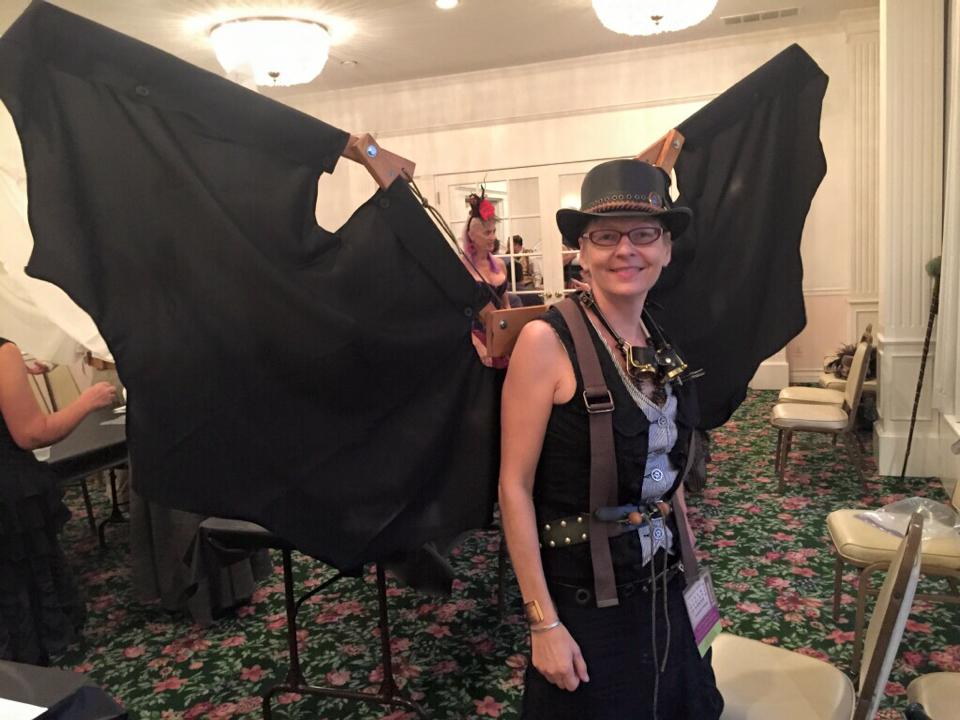
22279489_10155790772509294_1731285757739541249_nThis weekend I’m at the Gaslight Expo Convention in San Diego, where I’m a panelist with several other authors on Friday and Saturday. From 5-7 p.m. this evening I attended this awesome workshop with the Iron Tailor Bob Mogg and made these cool 7′ long retractable steampunk wings! I’m wearing them tomorrow with my “mad scientist” outfit. I’m going to be Dr. Calamity!

And that’s why I’m not writing this weekend.

I did write most of this week, though; I wanted to finish up Tashi’s backstory & send it to my dungeonmaster before this convention. Which I did, at about 10:30 p.m. last night. The backstory ended up being, er, a little long. My DM emailed me this morning: “You wrote 35 pages. You’re a woman possessed! I’ll read these this weekend!” Hope he enjoys it….

Here’s another scene from Tashi’s life. He’s 18 now, and initiated into the Chikhai Bardo sect of warrior-monks. I like the scene because it shows the results of earlier scenes where he’s slowly grown more fascinated by bones in particular, in part due to the not entirely savory influence of the mysterious Yeshi Vetali, whom he meet for the first time when he was eight and has met several times since. Tashi’s gone just a bit off the deep end, although he doesn’t realize it. Yangchen is his friend in the monastery, a fellow cohort member — tougher and more pragmatic than Tashi by far.

*18*

“I heard some of the younger initiates whispering about this place, but I didn’t think the rumors were true.”

Tashi opened his eyes. Yangchen stood in the doorway of his meditation hut, blocking the sunlight, so that he couldn’t see the expression on her face. He didn’t need to, though. The tone of her voice and the tension in her silhouette were both clear enough.

“Stories?” he asked, confused.

She gestured inside.

“They’re calling this the necromancer’s hut,” she said, grimly.

He looked around, surprised. “Why?”

She ducked through the low door and snatched up a bird skeleton that he’d perched on one of the hut’s bone shelves. Its delicate bones, sealed together with resin-and-charcoal glue, snapped in her grip.

“This!” She thrust the damaged skeleton into his face. “What is this?”

“The skeleton of a wren,” he replied, mildly.

She closed her tattooed fist, shattering it. Tashi felt a pulse of irritation. In response, he took a deep breath, letting it out slowly. Yes, he was irritated. No, there was no good reason for it.  Let it go. It was only a skeleton. No, it had been a skeleton. Now it was just trash.

Unless he mended it again. Wait! He cocked his head. What was the difference between a skeleton and trash? he wondered. Nothing but a thought. A thought and, perhaps, a spell.

Yangchen’s voice broke into his thoughts.

“Why did you put it back together?” She opened her hand, letting the broken bones fall to the floor of the hut. “Why did you bring it here, into your meditation hut?”

“I wanted to see how a bird’s’ wings were constructed.” Tashi felt distracted, gazing at the tiny bone fragments scattered over the stone. He wished she’d be quiet a moment, so he could pursue his latest insight. Could a spell actually change the nature of a thing, or was it still all a matter of thought and perception? Bone was bone. But sometimes it was perceived as a skeleton. And sometimes as trash. Nothing had changed but perception in the viewer’s mind. Concepts. Did spells change concepts?

“This is sick, Tashi. Sick at best.” She glared at him. “And evil at worst.”

He sighed and looked around, attempting to see what she saw.

“It’s not evil,” he objected. “I haven’t animated anything. I don’t even know how.”

Yes, he’d put a number of skeletons together over the last two years; it was something to do with his hands. Most of the bones he found in the forest and mountain passes were loose, though, carried far from the original skeleton by scavengers or the weather. Those he’d started to cram into the chinks in his hut walls and roof, sealing the gaps between them with a little mud to help keep out the weather. They’d worked well. Turning the bones into small shelves had been more of a challenge, but he was pleased with what he’d done; they held his small collection of complete skeletons so that he could gaze on them while he meditated, mentally reconstructing their organs and muscles and tendons. They reminded him how fragile and complex life was, and how quickly it came and went.

“What do you mean, it’s not evil? You’re decorating a sacred space with dead bodies!”

Tashi opened his mouth to protest — surely after seven years studying with the monks, Yangchen knew as well as he did that there was nothing sacred about his hut, no more than there was anything sacred about the mountainside it sat upon. But she had grabbed the front of his robe and hauled him to his feet.

“There’s a rule about fighting outside of the training hall,” he reminded her, resting his hands over hers. The no-fighting rule was often broken by initiates, to be sure — and Yangchen had been one of the worst offenders — but they were both eighteen-year-old ordained monks now. Fighting without permission could get them thrown out of the order.

“We’re going down to talk to Master Tsering,” she said, firmly. “I’ve been worried about you for a long time, Tashi. Now that I see all this — I wish I’d said something earlier.”

“You were worried about me?”

“Of course! You’re my best friend, Tashi, but ever since you decided to ordain, you’ve been avoiding me and acting strangely! Always pushing the monks to tell you more about death and dying, asking for stories about ghosts and rolangs and yidags every time a wanderer stays in the gompa, volunteering to help out at every single funeral —”

“Master Tsering doesn’t let me,” Tashi reminded her. It was a constant source of disappointment.

She shook him.

“Of course he doesn’t let you! I can’t even imagine what you’d do if he ever let you help out — turn one of our people into some horrible sculpture?”

Tashi gave her a hurt look.

“The Xiat didn’t want their bones broken,” he said, defensively. She stared at him, uncomprehending. He tightened his hands around hers and took a deep breath. “I’m just trying to be a good student. I’m just trying to understand.”

“This isn’t understanding,” she protested. They were standing so close that he could smell the wood smoke on her robes and feel her breath on his face. Her hands were warm beneath his, not at all like Yeshi Vetali’s. The warmth surprised him, a little. He touched people so seldom in the monastery that he’d forgotten how warm they were. “This is … this just playing.”

Playing. The word pierced him and struck a sensitive spot. He closed his eyes, trying to diagnose the pain. Playing? Was that what he was doing? Making toys? Building his own ossuary? Playing at being Yeshi Vetali?

“I don’t want you to get thrown out,” Yangchen continued, more softly. Tashi’s eyes snapped open.

For a moment their gazes met and slipped past each other’s defenses. They each saw, in that crystal moment, the uncertain vulnerability the other was trying to hide from the world.

Then, like one, they both took a step backward, jerking their hands away from each other.

Tashi ran his hands over his face, shaken. When he raised his eyes, he saw Yangchen gazing at him with apprehension.

“I’m sorry,” he said, unsteadily.

She nodded. “Me, too.”

He looked around, feeling as though the world had shifted around him. Bones. That’s all they were; bones. It didn’t matter if they were glued together or scattered on the forest floor. They had no more value adorning his hut than they did smashed on the floor. He’d been proud of the work he’d put into them, he realized now with a touch of shame; he’d become attached to the thought of Yeshi Vetali coming back someday and being impressed by what he’d built.

But three years had passed since she’d left. He had to assume that she wasn’t coming back.

“I’ll get rid of it.” He grabbed the shelf the bird had been sitting on, snapping it off. Suddenly it wasn’t a shelf anymore. Not a shelf and not trash. Just bone and mud and resin glue. Exactly that and nothing more.

Like the attraction between him and Yangchen. It was what it was. Exactly that and nothing more.

“I still think you should talk to Master Tsering,” she said, watching as he took the shelf outside and crumbled it, throwing the bones off the mountain ridge and letting the mud and glue fall to the ground.

He walked back in and picked up a rodent skeleton he’d glued together last year.

“If you don’t,” she pursued, “I will.”

“I’ll talk to him.” Tashi took the skeleton outside and hesitated. He turned, holding it. “Why is it easier to crush a bone shelf than to crush a skeletal rat?”

She ducked out of the hut and took it from his hands, snapping it into pieces without a second thought and throwing the bones off the ridge.

“I don’t know, Tashi,” she said, turning back to him. “Why?”

He sighed and walked back into the hut, wondering if Yangchen, for all her temper and desire to avoid death, might not be a better monk than he was.

***

Of course this isn’t the end of Tashi’s backstory; he humbly reports to Master Tsering, who decides the best way to deal with him is to initiate him into some of the sect’s more esoteric teachings; I based those teachings on Tibetan Buddhist chöd practices, which I’ve read some about here and there and find rather fascinating. They don’t necessarily resolve Tashi’s obsessions, but at least they channel them. Of course in the end Master Tsering, Yeshi Vetali, Tashi and Yangchen end up in a big confrontation that results in Tashi being lost from the monastery and wandering south, where he eventually meets up with the adventuring group that he’s currently working with in our Dungeons & Dragons campaign….

So I figure that was a decent amount of writing, even if the subject matter wasn’t too serious. I’m looking forward to hearing what my DM says about it. I’m hoping he’ll be amused and willing to use some of these hooks in later adventures — maybe Yeshi Vetali can show up and try to get Tashi to betray the rest of the group, or Yangchen can confront him and try to bring him back to the monastery. Who knows? That’s the fun of D&D; it’s mutual storytelling.

And although it’s not quite writing, I did sit on a panel about “secret history vs. alternate history in steampunk” with fantasy/sci-fi authors Tim Powers, Vernor Vinge, and Madeline Holly Rosing today. Tim Powers is the convention’s guest of honor and he was rattling off wonderful story ideas off the top of his head throughout the panel; pure creativity. I was so impressed! I’ll be sitting on another panel with all three tomorrow, too, on “science vs. fantasy in steampunk.” Thus the mad scientist costume. Should be fun!

Tashi_2 After finally writing some Right of Rule the week before, I didn’t get anything written on it this week. Instead, I took a writing detour and started writing the backstory for a Dungeons & Dragons character I’m playing every month or two down in Van Nuys with a group of old college friends. When the game started, it was about the third game various members of that group had started, run briefly, and abandoned (the other two being Shadowrun & Star Wars, for any gamer geeks reading this). I was skeptical that the game would continue, so I put minimal effort into the character, writing a short three paragraphs — Tashi is a monk who was born into a northern mountains nomadic tribe, studied for ten years (from age 10-20) at a monastery, and has recently traveled down into the southern lands where the game was set with his staff and begging bowl. He’s rather striking-looking, with the entirety of his skin covered with inked sutras (I was inspired by Thailand’s Sak Yant tattooing and pushed it to the fantasy degree).

But the campaign’s been going on for a couple of years now, probably four or five times a year, and the weekend before last I spent some time with some enthusiastically creative middle-school girls who wanted to learn D&D and threw themselves head-first into backstory creation. I decided I’d better step up my own game and finally fill in the big blanks in my character’s past for the dungeonmaster to use and abuse. (Those backstories *always* come back to haunt you….!)

And as of this morning, I’ve written 26 pages of linked scenes from his past, LOL! Talk about going from nothing to a small novella.

Here’s the second scene I wrote. In the first, Tashi was six and at a sister’s sky burial. When he asks if having her body broken will hurt her, a monk takes him aside and tells him about the three traps of death (returning as undead, going to heaven or hell, and being reborn). Tashi’s culture is one in which death isn’t seen as something scary but is, instead, taken very seriously as a chance to reach nirvana. The monk encourages the little boy to be prepared for it. In the next scene, Tashi is eight and meets a mysterious character who will keep dropping in and out of his life up until the point where he leaves his own land and travels south. I have borrowed liberally from Tibetan culture (AD&D just calls the peoples of these mountains “snow barbarians”; yuck! The game, especially in its earliest forms, wasn’t too progressive) but of course changed it to fit the fantasy culture of D&D. More caveats — its just gamer writing, not “serious” writing, so I’m not trying to make it novel-quality….

***

Early winter storms had already covered the ground with snow by the time the Nahm-Ka reached their winter settling grounds. Another storm greeted them as they entered the valley, blowing sleet and snow into their eyes, so that they didn’t linger but quickly broke into family groups to seek out their closed-up homes. While his mother and Tsundue started the hearth fires in their winter home, Tashi stayed outside with his two older brothers, struggling against the biting sleet to secure the family’s yaks in their stone enclosure. They’d been hearing the winter wolves howl for hours, which hadn’t been so bad when they’d been with the rest of the clan, but now that everyone had separated, the sound was more frightening. Tashi’s oldest brother, fourteen-year-old Tenzin, told him at least the howling meant that there weren’t any ice wyrms around. Wolves were a lot easier to kill than remhoraz.

“Ice wyrms don’t come this far south,” his ten-year-old brother Norbu objected. Tenzin shrugged and grinned at him. Tashi relaxed. Tenzin was only teasing, then, trying to scare them.

Their father and the other clan warriors had left a few hours ago to make sure the monks and their staff reached the gompa, the cliff monastery, safely. With Mother in the house, Tenzin was in charge, which irritated Norbu no end, although Tashi didn’t mind. As the youngest, smallest child, he was used to being bossed around.

Suddenly a new note rose over the howling of wind and wolf — the deep, gasping sound of the dung dkar, or conch horn. Tashi looked up, his eyes wide. Next to him, their mastiff, Ketu, growled.

“They can’t be calling us to worship now, can they?” Norbu asked, hanging off the gate wooden.

“It must be an alarm.” Their oldest brother, Tenzin, slapped the last yak on the hindquarters, urging it into the enclosure. “I’ll go find out what’s happening.”

Ketu’s growling grew louder and he turned to face the whirling snow and darkness, his thick collar standing on end. The howling wolves suddenly fell silent.

“Shit.” Tenzin grabbed the heavy hunting spear he’d left propped by the enclosure. “Norbu, take the lantern.”

Norbu snatched it up, holding it out a full arm’s length.

“I don’t see anything!” he said with a quavering voice.

“Shhh!”

Tashi held his breath as his brothers fell silent. Ketu took a few stiff steps farther out in the snow, teeth bared. Behind them, the yaks grunted and moved restlessly in the stone enclosure.

“Quiet them, Tashi,” Tenzin ordered. Tashi obediently slipped through the gate slats and threw his arms around the closest yak.

“Hush,” he whispered in its nervously flicking ear. “Don’t move.”

The giant animals paid no attention, shifting back and forth. Tashi moved from one to the other, trying to calm them. Ice wyrms hunted by vibration, he knew from the hunters’ tales, so it was important to keep the yaks from moving too much.

A distant scream pierced the air.

“Come on!” Tenzin began running, spear in hand, and Norbu scrambled behind him with the lantern.

“Wait for me!” Tashi shouted, pushing his way through the yaks. But by the time he reached the gate, his brothers had vanished into the darkness. Sleet stung his eyes and the wind sent snow swirling up around him. “Tenzin? Norbu?”

He could barely hear Ketu barking over the wind, and the long, mournful intonation of the dung dkar.

He clutched the wooden slates of the gate with his gloved hands as he stared blankly into the darkness. They left me! He hated it when they did that.

“Stupid brothers,” he muttered. “I’m going home, then.” He couldn’t see anything, but his house wasn’t that far away; just straight across the pasture where the yaks grazed during the day. From the enclosure gate, all Tashi had to do was keep walking straight, and he’d end up safely back home, where his mother and sister would be waiting for him by a crackling fire with hot butter tea and tsampa. Let Tenzin and Norbu run around in the dark and the cold; he’d be warm and comfortable!

He drew in a deep breath and slipped through the slats again.

Straight across. Easy. He began walking, his hands held out in front of him even though he knew there was nothing to run into until he reached the house. The wind pushed against him as if trying to send him the wrong way and he pushed back, determined not to be fooled. Just put one foot in front of the other, he encouraged himself. Mother will have a lamp in the window.

He wasn’t sure how long he’d walked when he finally tripped over a stone and fell into the snow. He pushed himself up, turning his head blindly. There was no light to be seen at all.

“Tsundue?” he shouted. “Mother?”

There was no answer. Tashi stood, brushing the snow off his fur-lined pants and jacket.

I’m lost, he decided. He stood still, listening. Still no more howling. Or screams. Just the wind, and creaking trees, and the snow crunching under his feet.

I’m alone, he thought, amazed. He brightened. I’m alone!

He’d thought a lot about what the monk had said last year, when his sister had died — that everyone should practice for the day that they had to face their death alone. He’d wondered how he could practice, because he was never alone. But here he was, all by himself. He smiled into the darkness and the snow.

It’s just like being dead!

He squatted and scraped at the snow until he found some grass. Holding it up in his gloved hand, he focused. The grass burst into flame and was immediately blown out by the wind.

Oh.

He lit another clump of grass. It immediately went out, too.

A chill ran down his back. The bardo wasn’t supposed to work like that, he thought. It wasn’t supposed to extinguish his hard-earned efforts so easily.

He looked up into the darkness, feeling the cold wind on his face and the chill seeping around the cuffs of his jacket and pants, too. He remembered his father telling him and his brothers how to dig into the snow if they were ever on their own and needed shelter.

But if you rest while you’re in the bardo, you wake up without any memories and get born again, he thought. That was no good. He didn’t want to be reborn; he wanted to find nirvana.

He stood and began walking again. Better to be tired and cold and keep moving than to stop to sleep and lose everything, he told himself.

He was starting to lose the feeling in his face and hands when he finally saw a glimmer of light. He fixed his eyes on it and started to run, but his feet felt heavy and clumsy.

Nirvana!” he shouted. “Nirvana! Wait for me!”

To his relief, the light began to move toward him. He waved both arms, stumbling through the snow.

The glow finally resolved into an eerie blue light limning a gnarled staff of pieced-together bone and antler, held by a pale hand. Tashi stopped, startled, as its wielder materialized through the whirling snow. She was a thin stranger wearing nothing but a tattered monk’s robe, her flesh defiantly bared to the winter’s wind. Bone and horn beads were braided in her long, pale hair, and although her skin was tattooed like all monks’, the letters were strange, unlike any others Tashi had ever seen. A carved conch-shell dung dkar hung from her belt, next to a silver-and-turquoise inlaid kapala, a skullcup.

“Well, well,” she said, regarding him with interest. “What have we here?”

She wasn’t nirvana. He didn’t think so, anyway.

Tashi pulled himself together and gave her a cautious bow.

“Are you a god or a demon?” he asked.

She cocked her head. He couldn’t tell how old she was; her face wore weathered wrinkles around the eyes and mouth, but her flesh still seemed firm and strong.

“Neither, yet,” she replied. “And you?”

He shook his head. “I’m Nahm-Ka,” he said. And then, cautiously, “but I might be dead.”

“Really? So young?”

“I’m eight.”

“Hmm. A bit young for my taste, even if you are dead.” She held out a hand. “We’d better walk together for a while.”

“I’m not supposed to talk to gods or demons,” he said, solemnly. “Or mothers.”

“Well, I’m not any one of those things, so you’re safe.”

Reassured, he stepped forward and took her hand. She leaned down and sniffed him.

“I’m sorry to tell you this, child,” she said with an air of regret, “but you’re still alive. For the time being.”

“Oh.” If he wasn’t dead, then he supposed he wasn’t in the bardo. That must mean he was still in the winter valley. “Are you a monk? Are you going to the gompa?”

“Yes, I am, and no, I am not. I knocked on the monastery door a little earlier tonight, but nobody would let me in.” She began walking, still holding Tashi’s hand.

“Why not?” he asked, looking up at her.

“We have some differences of opinion, your order and I. So I had to take what I wanted from your village, instead.”

“If you need a place to spend the night, Mother would let you sleep by the fire,” Tashi volunteered.

“Would she? How many are at home besides your mother?”

“Just her and my sister,” Tashi said. “Father and my brothers are out here. Somewhere.” He looked around. “They might be lost, too.”

“I see.” She gave him a sidelong glance. “Let’s not bother your mother, then. What’s your name?”

“Tashi.”

She nodded slightly. “An auspicious name, Tashi. I’m called Yeshi Vetali.”

“Vetali?” Tashi stopped in his tracks, staring up at her. “That’s a monster name!”

“Is it?” she asked, mildly. “Then I must be a monster.”

A monster! Not a god or a demon, but a monster. Tashi frowned. That wasn’t fair. The monk hadn’t warned him that there would be monsters in the bardo.

But he wasn’t in the bardo, was he? He was still in the valley. He looked around, confused. For the first time, he noticed that there were other shapes moving around them, silent silhouettes barely visible in the limited light of her staff. They walked strangely, not like animals but not like people, either.

“Who’s that?” he asked.

“More monsters. Would you like to see?”

Would he? Tashi hesitated, then nodded. If I can see them, he reasoned, they can’t grab me from the dark.

Yeshi Vetali called out in a strange language. In response, seven of Tashi’s neighbors staggered into the circle of light, men and women he’d known all his life — except, as he looked into their eyes, he knew at once that the people he’d grown up with were gone.

Then his father stepped into the light, the eighth of the group. For a moment Tashi started to call out to him, excited, but then — then he saw his father’s eyes.

His father was gone, as well.

“They aren’t monsters,” he said, crushed. “They’re just dead.”

Undead,” Yeshi Vetali corrected. “And therefore they are, too, monsters.”

“No, they’re not. That’s my father,” he said, pointing. “And those are my neighbors.”

The monk regarded his father’s corpse thoughtfully, then looked down at Tashi.

“No, child,” she said. “Not anymore.”

Tashi stared at her a moment, his thoughts feeling sluggish, and then abruptly understood.

“They’re in the bardo?”

“Yes. Rather freshly so, I’m afraid. Sorry about your father, child. Wrong place, wrong time.”

He stared at her. She turned him around, facing him toward his father’s body again.

“Say goodbye.”

Tashi took a step forward, hesitated, and then forced himself to take another, until he was standing in front of his father’s corpse. It swayed slightly, stiff-kneed, its vacant eyes fixed on some point in space. Tashi stared at it, feeling a familiar sense of loss pierce him, the same loss he’d felt when he’d finally realized, really and truly realized, that Dema was never coming back. He pulled off his glove and reached out to touch his father’s hand with his bare fingers.

His father’s flesh was already cold.

Somehow, that made it easier.

“You’re supposed to break the bodies,” he said, looking over his shoulder. “That way the spirits know they can’t come back.”

“They can’t come back, anyway,” she replied. “But don’t worry. These bodies will be broken soon enough.”

“When?”

“Oh, within a few months, I expect. Depends on what my enemies have in store for me.”

Tashi turned back to his father, or rather, the rolang that had been his father. He wished he were a rogyapa, or maybe even just a few years older and a few feet bigger, like Tenzin, so that he could grab his father’s body and run away with it, take it up to the burial site and make sure it was safely eaten away by the vultures. But he wasn’t, and he knew there was no point wishing otherwise.

“If you’re still watching, Papa,” he said, softly, “it’s time to go. Don’t listen to any gods or demons and don’t sit down to rest anywhere. Just keep walking and walking until you reach nirvana.”

The corpse swayed back and forth a little. Tashi turned and trudged back.

“You aren’t afraid?” the monk asked as he rejoined her. He shook his head. “Why not?”

“They’re my friends and family,” he said, simply. “And you said you wouldn’t hurt me.”

“I might have lied. I am a monster, after all.”

He looked into her face, but despite her words, he didn’t see any threat in her expression; just curiosity.

“Well, either you aren’t going to hurt me, or you’re going to kill me and turn me into a monster, too,” he said at last. “If you kill me, that’s all right. I’ve been practicing to die.”

She gave a bark of laughter. “Have you? Good boy. Very farsighted. Practice makes perfect. Come along.”

She left him outside the Rabgyals’ house. When he knocked on the door, the family greeted him with exclamations and brought him close to the fire to warm himself. He’d seen their daughter Pema among Yeshi Vetali’s rolangs, but he didn’t say anything to them, because he knew it would only make them sad. Nor did he say anything the next day, when he returned home to be greeted and scolded by his mother and his older sister and brothers, all of whom had come home safely at last. Nor did he say anything when his clan finally realized that eight of its warriors, including his father, were missing, lost in the storm on their way down from the monastery. The village held on to hope for a few more weeks, but then finally accepted the inevitable. The monks chanted for two full days, and Tashi hoped that wherever his father’s spirit was, he would hear the chanting and be comforted.

***

So far I’ve written scenes taking Tashi up to age 17; I need to get him to 20. Right now I’m trying to decide how he leaves his monastery. With Yeshi Vetali feeding him a perspective over the years that his own monkish order doesn’t much agree with — that undeath is a perfectly acceptable alternative — he may end up leaving in disgrace. Not that he consciously chooses to do something terrible, but he’s rather trusting, and he doesn’t always think things through very carefully. Not to mention being immersed in a philosophy in which good and evil are seen primarily as mental concepts unrelated to reality. (Tashi’s true neutral in alignment, for the D&D geeks.) However he leaves won’t affect where we are in the game right now, since he’s so far from home, but it’ll give the dungeonmaster hooks that he can choose to exploit or not. I expect Yeshi Vetali will still be around by the time I finish the scenes … she’s a necromancer at best and undead herself at worst … for the DM to use if desired, and probably a few of Tashi’s monastery-mates, who may or may not have a grudge against him. We’ll see!

It’s been fun writing something different. With luck I’ll come back to Right of Rule refreshed after putting myself into a different kind of character’s headspace for a while.