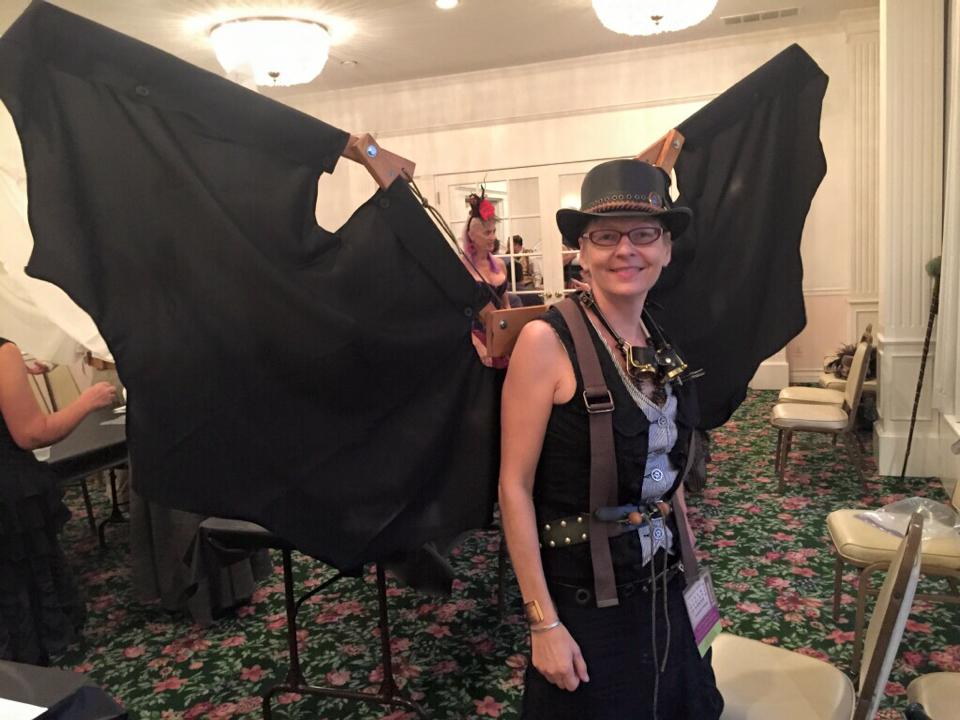
 This weekend I’m at the Gaslight Expo Convention in San Diego, where I’m a panelist with several other authors on Friday and Saturday. From 5-7 p.m. this evening I attended this awesome workshop with the Iron Tailor Bob Mogg and made these cool 7′ long retractable steampunk wings! I’m wearing them tomorrow with my “mad scientist” outfit. I’m going to be Dr. Calamity!
And that’s why I’m not writing this weekend.
I did write most of this week, though; I wanted to finish up Tashi’s backstory & send it to my dungeonmaster before this convention. Which I did, at about 10:30 p.m. last night. The backstory ended up being, er, a little long. My DM emailed me this morning: “You wrote 35 pages. You’re a woman possessed! I’ll read these this weekend!” Hope he enjoys it….
Here’s another scene from Tashi’s life. He’s 18 now, and initiated into the Chikhai Bardo sect of warrior-monks. I like the scene because it shows the results of earlier scenes where he’s slowly grown more fascinated by bones in particular, in part due to the not entirely savory influence of the mysterious Yeshi Vetali, whom he meet for the first time when he was eight and has met several times since. Tashi’s gone just a bit off the deep end, although he doesn’t realize it. Yangchen is his friend in the monastery, a fellow cohort member — tougher and more pragmatic than Tashi by far.
*18*
“I heard some of the younger initiates whispering about this place, but I didn’t think the rumors were true.”
Tashi opened his eyes. Yangchen stood in the doorway of his meditation hut, blocking the sunlight, so that he couldn’t see the expression on her face. He didn’t need to, though. The tone of her voice and the tension in her silhouette were both clear enough.
“Stories?” he asked, confused.
She gestured inside.
“They’re calling this the necromancer’s hut,” she said, grimly.
He looked around, surprised. “Why?”
She ducked through the low door and snatched up a bird skeleton that he’d perched on one of the hut’s bone shelves. Its delicate bones, sealed together with resin-and-charcoal glue, snapped in her grip.
“This!” She thrust the damaged skeleton into his face. “What is this?”
“The skeleton of a wren,” he replied, mildly.
She closed her tattooed fist, shattering it. Tashi felt a pulse of irritation. In response, he took a deep breath, letting it out slowly. Yes, he was irritated. No, there was no good reason for it. Let it go. It was only a skeleton. No, it had been a skeleton. Now it was just trash.
Unless he mended it again. Wait! He cocked his head. What was the difference between a skeleton and trash? he wondered. Nothing but a thought. A thought and, perhaps, a spell.
Yangchen’s voice broke into his thoughts.
“Why did you put it back together?” She opened her hand, letting the broken bones fall to the floor of the hut. “Why did you bring it here, into your meditation hut?”
“I wanted to see how a bird’s’ wings were constructed.” Tashi felt distracted, gazing at the tiny bone fragments scattered over the stone. He wished she’d be quiet a moment, so he could pursue his latest insight. Could a spell actually change the nature of a thing, or was it still all a matter of thought and perception? Bone was bone. But sometimes it was perceived as a skeleton. And sometimes as trash. Nothing had changed but perception in the viewer’s mind. Concepts. Did spells change concepts?
“This is sick, Tashi. Sick at best.” She glared at him. “And evil at worst.”
He sighed and looked around, attempting to see what she saw.
“It’s not evil,” he objected. “I haven’t animated anything. I don’t even know how.”
Yes, he’d put a number of skeletons together over the last two years; it was something to do with his hands. Most of the bones he found in the forest and mountain passes were loose, though, carried far from the original skeleton by scavengers or the weather. Those he’d started to cram into the chinks in his hut walls and roof, sealing the gaps between them with a little mud to help keep out the weather. They’d worked well. Turning the bones into small shelves had been more of a challenge, but he was pleased with what he’d done; they held his small collection of complete skeletons so that he could gaze on them while he meditated, mentally reconstructing their organs and muscles and tendons. They reminded him how fragile and complex life was, and how quickly it came and went.
“What do you mean, it’s not evil? You’re decorating a sacred space with dead bodies!”
Tashi opened his mouth to protest — surely after seven years studying with the monks, Yangchen knew as well as he did that there was nothing sacred about his hut, no more than there was anything sacred about the mountainside it sat upon. But she had grabbed the front of his robe and hauled him to his feet.
“There’s a rule about fighting outside of the training hall,” he reminded her, resting his hands over hers. The no-fighting rule was often broken by initiates, to be sure — and Yangchen had been one of the worst offenders — but they were both eighteen-year-old ordained monks now. Fighting without permission could get them thrown out of the order.
“We’re going down to talk to Master Tsering,” she said, firmly. “I’ve been worried about you for a long time, Tashi. Now that I see all this — I wish I’d said something earlier.”
“You were worried about me?”
“Of course! You’re my best friend, Tashi, but ever since you decided to ordain, you’ve been avoiding me and acting strangely! Always pushing the monks to tell you more about death and dying, asking for stories about ghosts and rolangs and yidags every time a wanderer stays in the gompa, volunteering to help out at every single funeral —”
“Master Tsering doesn’t let me,” Tashi reminded her. It was a constant source of disappointment.
She shook him.
“Of course he doesn’t let you! I can’t even imagine what you’d do if he ever let you help out — turn one of our people into some horrible sculpture?”
Tashi gave her a hurt look.
“The Xiat didn’t want their bones broken,” he said, defensively. She stared at him, uncomprehending. He tightened his hands around hers and took a deep breath. “I’m just trying to be a good student. I’m just trying to understand.”
“This isn’t understanding,” she protested. They were standing so close that he could smell the wood smoke on her robes and feel her breath on his face. Her hands were warm beneath his, not at all like Yeshi Vetali’s. The warmth surprised him, a little. He touched people so seldom in the monastery that he’d forgotten how warm they were. “This is … this just playing.”
Playing. The word pierced him and struck a sensitive spot. He closed his eyes, trying to diagnose the pain. Playing? Was that what he was doing? Making toys? Building his own ossuary? Playing at being Yeshi Vetali?
“I don’t want you to get thrown out,” Yangchen continued, more softly. Tashi’s eyes snapped open.
For a moment their gazes met and slipped past each other’s defenses. They each saw, in that crystal moment, the uncertain vulnerability the other was trying to hide from the world.
Then, like one, they both took a step backward, jerking their hands away from each other.
Tashi ran his hands over his face, shaken. When he raised his eyes, he saw Yangchen gazing at him with apprehension.
“I’m sorry,” he said, unsteadily.
She nodded. “Me, too.”
He looked around, feeling as though the world had shifted around him. Bones. That’s all they were; bones. It didn’t matter if they were glued together or scattered on the forest floor. They had no more value adorning his hut than they did smashed on the floor. He’d been proud of the work he’d put into them, he realized now with a touch of shame; he’d become attached to the thought of Yeshi Vetali coming back someday and being impressed by what he’d built.
But three years had passed since she’d left. He had to assume that she wasn’t coming back.
“I’ll get rid of it.” He grabbed the shelf the bird had been sitting on, snapping it off. Suddenly it wasn’t a shelf anymore. Not a shelf and not trash. Just bone and mud and resin glue. Exactly that and nothing more.
Like the attraction between him and Yangchen. It was what it was. Exactly that and nothing more.
“I still think you should talk to Master Tsering,” she said, watching as he took the shelf outside and crumbled it, throwing the bones off the mountain ridge and letting the mud and glue fall to the ground.
He walked back in and picked up a rodent skeleton he’d glued together last year.
“If you don’t,” she pursued, “I will.”
“I’ll talk to him.” Tashi took the skeleton outside and hesitated. He turned, holding it. “Why is it easier to crush a bone shelf than to crush a skeletal rat?”
She ducked out of the hut and took it from his hands, snapping it into pieces without a second thought and throwing the bones off the ridge.
“I don’t know, Tashi,” she said, turning back to him. “Why?”
He sighed and walked back into the hut, wondering if Yangchen, for all her temper and desire to avoid death, might not be a better monk than he was.
***
Of course this isn’t the end of Tashi’s backstory; he humbly reports to Master Tsering, who decides the best way to deal with him is to initiate him into some of the sect’s more esoteric teachings; I based those teachings on Tibetan Buddhist chöd practices, which I’ve read some about here and there and find rather fascinating. They don’t necessarily resolve Tashi’s obsessions, but at least they channel them. Of course in the end Master Tsering, Yeshi Vetali, Tashi and Yangchen end up in a big confrontation that results in Tashi being lost from the monastery and wandering south, where he eventually meets up with the adventuring group that he’s currently working with in our Dungeons & Dragons campaign….
So I figure that was a decent amount of writing, even if the subject matter wasn’t too serious. I’m looking forward to hearing what my DM says about it. I’m hoping he’ll be amused and willing to use some of these hooks in later adventures — maybe Yeshi Vetali can show up and try to get Tashi to betray the rest of the group, or Yangchen can confront him and try to bring him back to the monastery. Who knows? That’s the fun of D&D; it’s mutual storytelling.
And although it’s not quite writing, I did sit on a panel about “secret history vs. alternate history in steampunk” with fantasy/sci-fi authors Tim Powers, Vernor Vinge, and Madeline Holly Rosing today. Tim Powers is the convention’s guest of honor and he was rattling off wonderful story ideas off the top of his head throughout the panel; pure creativity. I was so impressed! I’ll be sitting on another panel with all three tomorrow, too, on “science vs. fantasy in steampunk.” Thus the mad scientist costume. Should be fun!
No comments
Comments feed for this article
Trackback link: https://blogs.callutheran.edu/paglia/more-tashi/trackback/