Saturday, March 14, 2020: Gran Via, Madrid, Spain: The U.S. president had just announced the travel restrictions that would come into effect on March 13, and my colleagues, with whom I was sharing a swanky rental apartment high over Gran Via, had been on the phone for hours trying to get flights before their scheduled March 14 return. One succeeded in rebooking for a March 13 flight; the other two ended up leaving as scheduled, on Saturday, March 14th — although they upgraded their seats in order to get some enjoyment out of the flight before the chaos they knew would greet them in LAX. Meanwhile, below us in the city, the pharmacist around the corner had started wearing a facemask. Antiseptic wipes, hand sanitizer, and thermometers were utterly unavailable. One of the big flashing marquees on the Gran Via, normally lit up with video advertising, showed a COVID-19 warning. Coronavirus fliers were showing up on the metro tunnel walls. Restaurants had just been closed, and the wide main street, normally bustling with tourists, had emptied.
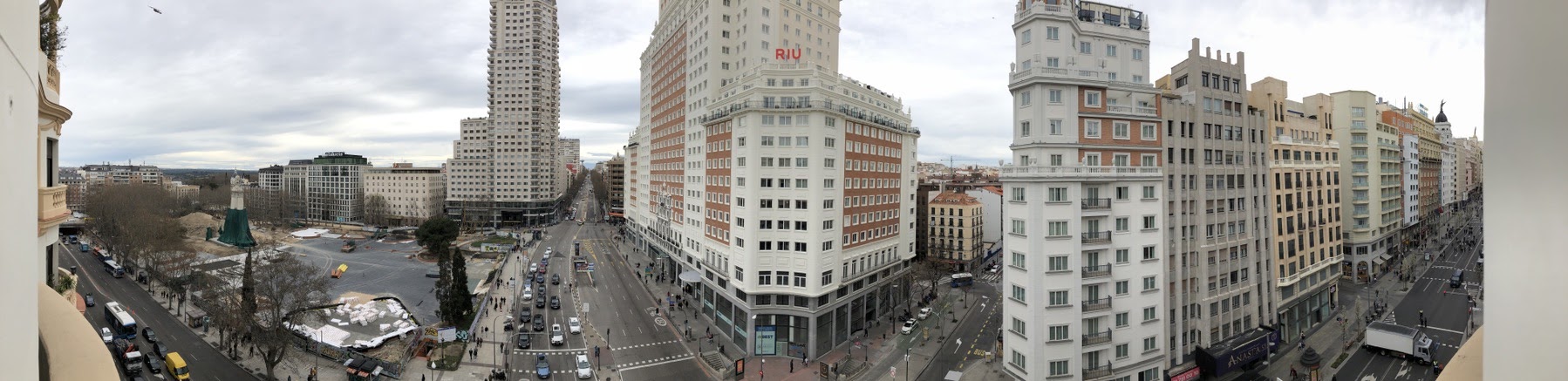
View from our apartment over the Gran Via, Madrid
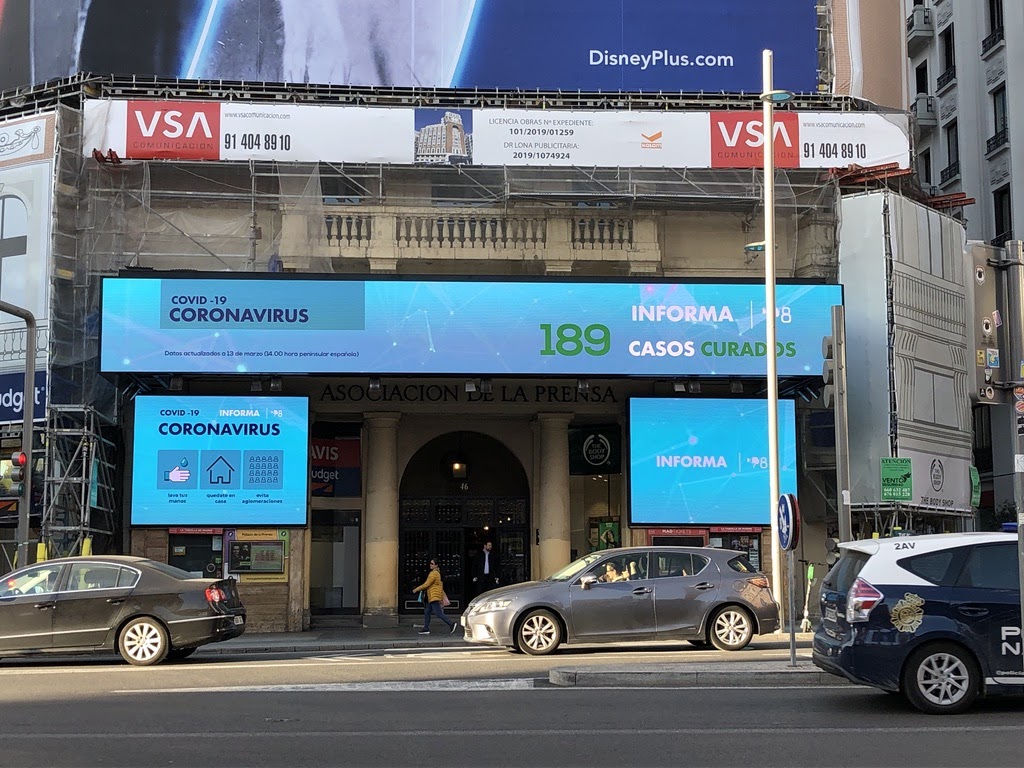
Electronic sign on the Gran Via
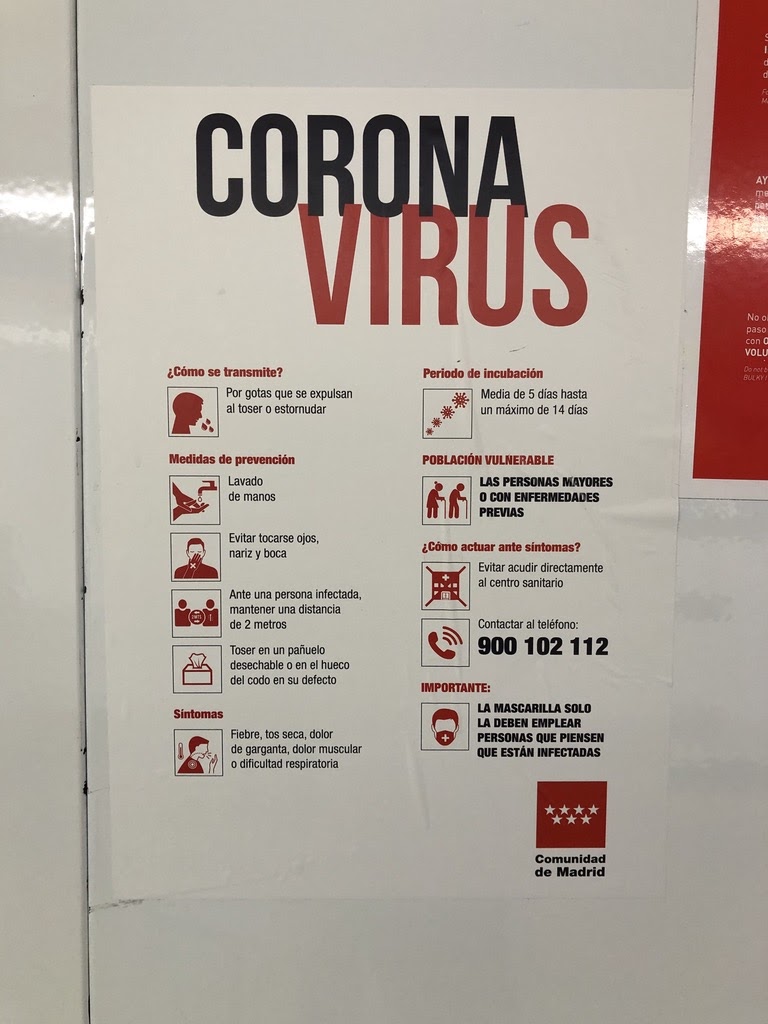
Signs in the metro tunnels
After my friends had left to catch their taxi to the airport, I was alone in the apartment. I’d been traveling with others since February 3, and I felt both some apprehension and excitement about beginning the solo leg of my journey. When it was finally time to leave, I shouldered my backpack, wrapped a scarf around my nose and mouth, and headed down to the nearby metro station.
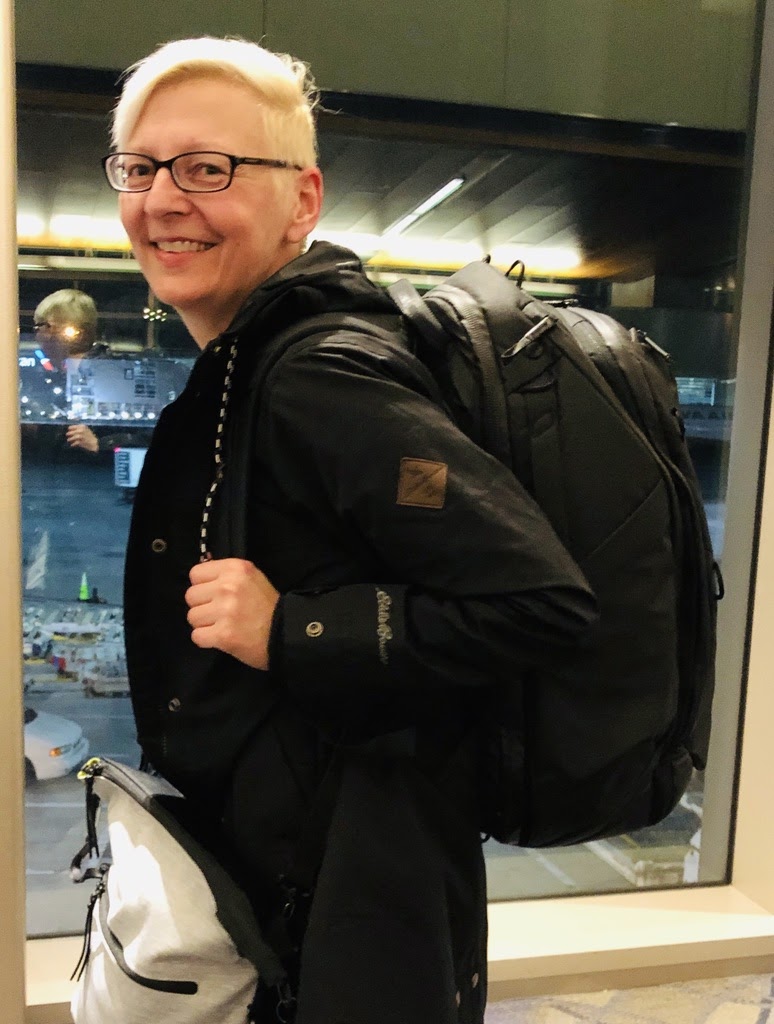
Better times: In LAX, February 3, I was excited about backpacking through Europe and the UK for 19 weeks.
On March 14 I was five and a half weeks into a 19-week sabbatical trip backpacking around Europe. So far I’d visited Madrid, Alcalá de Henares, and Barcelona in Spain; Lisbon, Portugal; Marrakesh, Morocco; and Copenhagen, Denmark. Now I was headed to Granada, Spain. I’d bought my ticket to visit the Alhambra back in January; I’d be visiting it tomorrow, Sunday, March 15. And as for the rest of it? I wasn’t afraid of catching the novel coronavirus; I half expected I’d already had an asymptomatic case, given the amount of traveling I’d done already on trains, planes, buses, taxis, and subways. Besides, I was still (relatively) young and healthy, and this thing only affected the old, right? As long as I was careful, I’d be fine. I’d been anticipating this year-long sabbatical for ages. I’d given up my apartment for this trip. I’d even agreed to go on ¾ pay for two years in order to pay for the second semester of sabbatical! Dammit, this was my post-six-years-as-department-chair, post-cancer, post-revising-the-entire-faculty-governance-system reward, and no stupid superflu was going to stop me from enjoying it!
The guards X-raying luggage at the train station wore masks and gloves, and about a third of the people waiting for trains wore masks. Everybody was trying to stay spaced apart. None of the concessions were open. I read while I waited, glad of my scarf every time somebody in the station coughed, until my train was announced.
Virtually nobody was aboard the train; only two others sat in my coach, all of us rows apart. The train concessions were all closed, of course. I took a photo of the empty coach. It felt like a good setup for a horror movie scene … the kind of movie where the other two people in the coach and I would end up fighting together for our lives against monsters. As it turns out, the trip was eventless, and we never even exchanged a word.
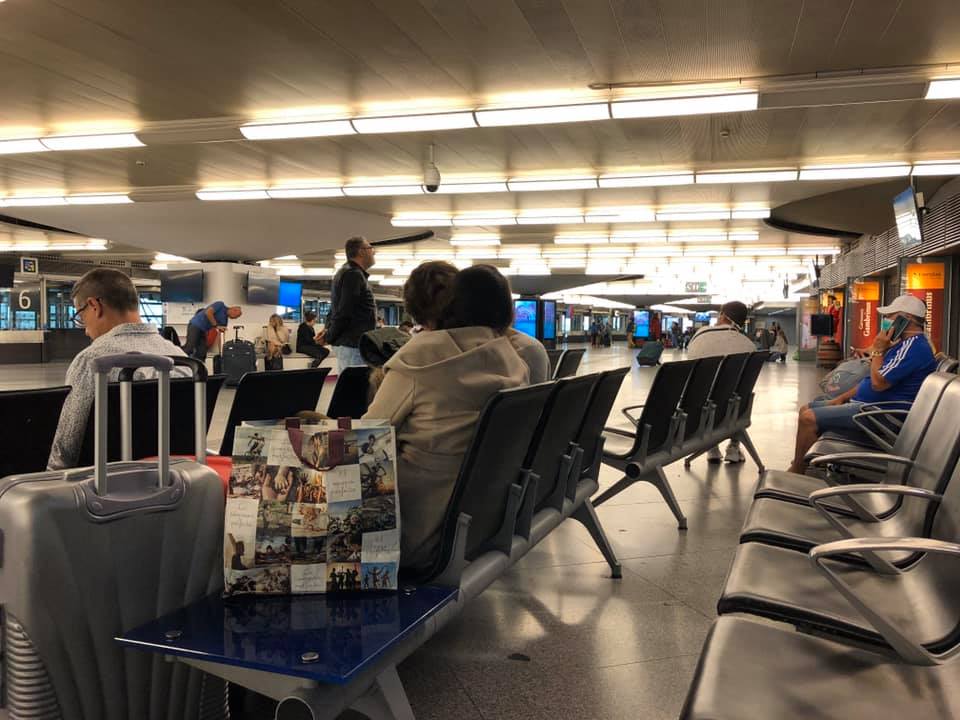
The Atocha train station wasn’t very crowded for a Saturday afternoon.
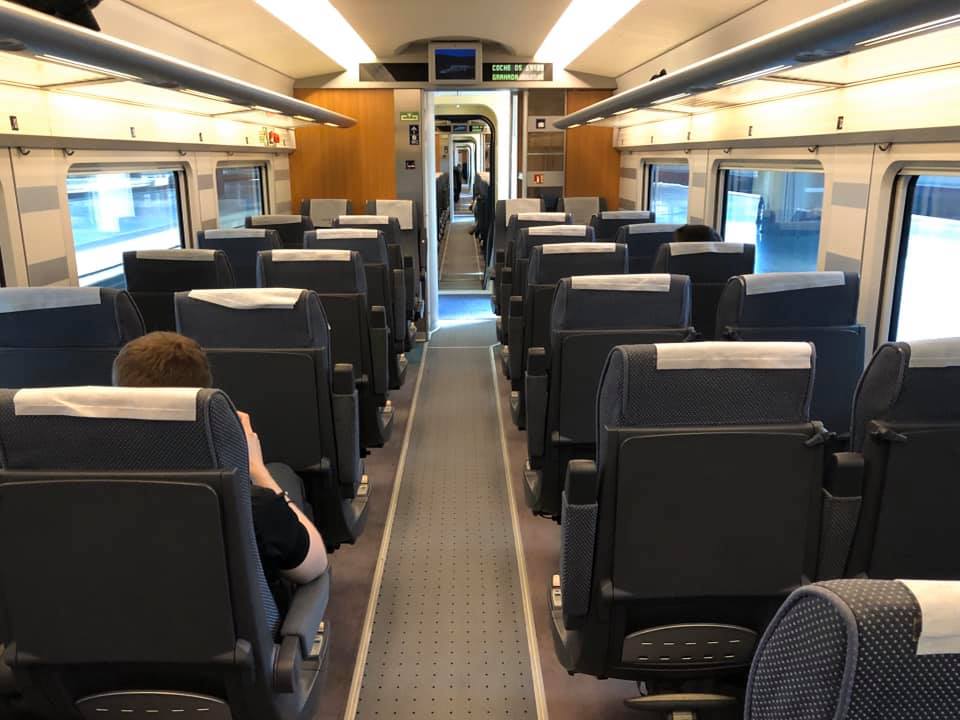
… and neither was the express train to Granada.
Granada’s train station was also surprisingly empty for a Saturday afternoon. I took a taxi from the train station to my rental and asked the driver, in my halting Spanish, how things were going in the city. Everything’s closed, I was informed; nobody’s here. The Alhambra? I asked. Yes, the Alhambra was closed. Restaurants. Stores. Everything. He looked disgusted. I was disappointed. I’d just visited a crowded Sagrada Família in Barcelona a week ago; how could the Alhambra be closed now?
My spirits rapidly sinking, I found my rental apartment; the grocery store right next to it was shuttered and dark. Too bad; that’s where I’d been planning to buy the night’s meal, since the restaurants in Spain were all closed. I’d brought some bread, cheese, and chorizo with me from Madrid, but that was all. I dropped off my backpack, confirmed that the landlord hadn’t left me anything in the fridge (sometimes they do, sometimes they don’t), and headed outside in search of sustenance. I found a small market a few blocks away that was still open, although the shelves had large gaps in them. I took a photo and posted it to Facebook: “It’s a little scary,” I admitted in my post, “and definitely not the sightseeing sabbatical I had been anticipating for so long….” Still, the market had cheap wine and enough vegetables and packaged food to cook up a pot of homemade soup. I took my groceries back to the apartment, wondering when and if the stores would be restocked soon. I was supposed to stay in Granada for four nights, then take the train to Cordoba and stay there for another two nights. Would the mosque in Cordoba be open? I’d already bought a ticket to see it, too. …Well, if I ate bread and cheese tonight and made soup tomorrow, I figured I probably wouldn’t starve, at least. That was something. Hopefully Cordoba’s stores would be open.
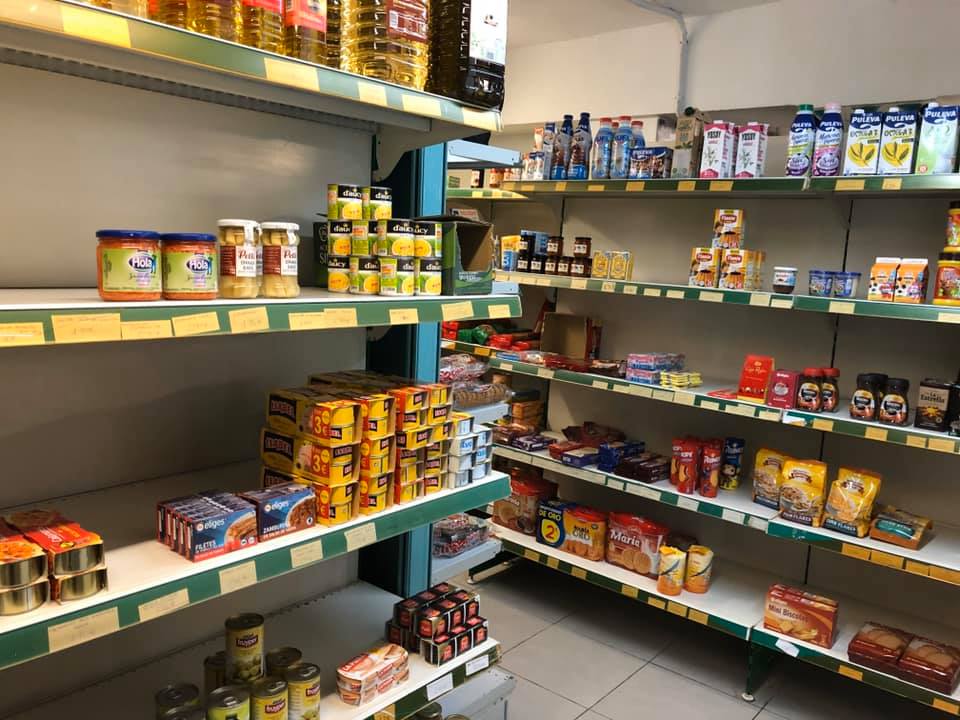
The market in Granada had been well picked-over.
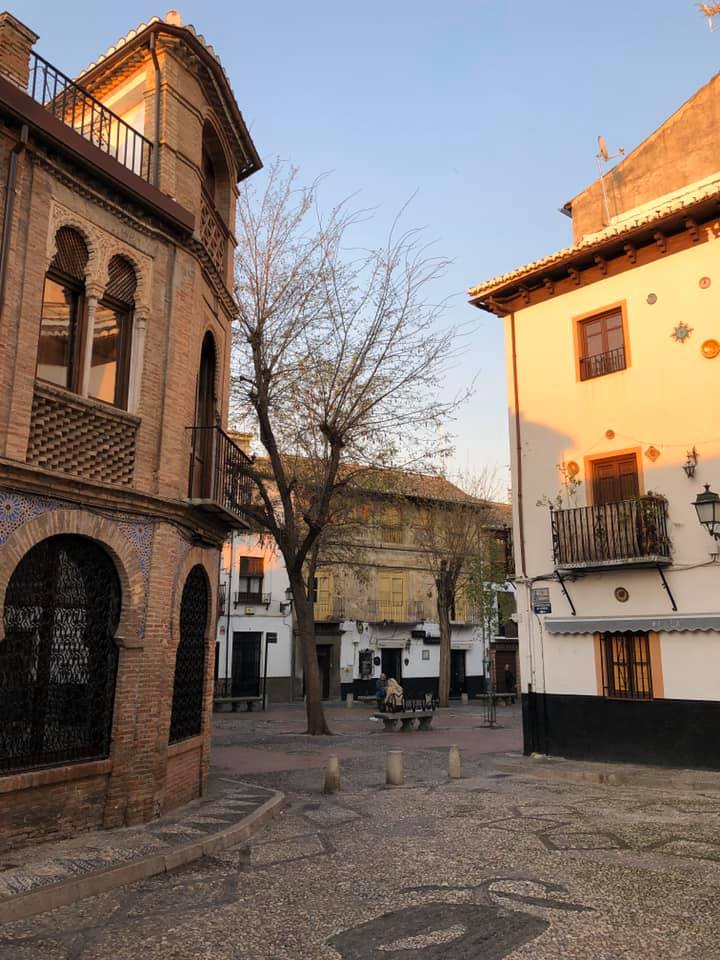
The plaza by my rental apartment was all but empty.
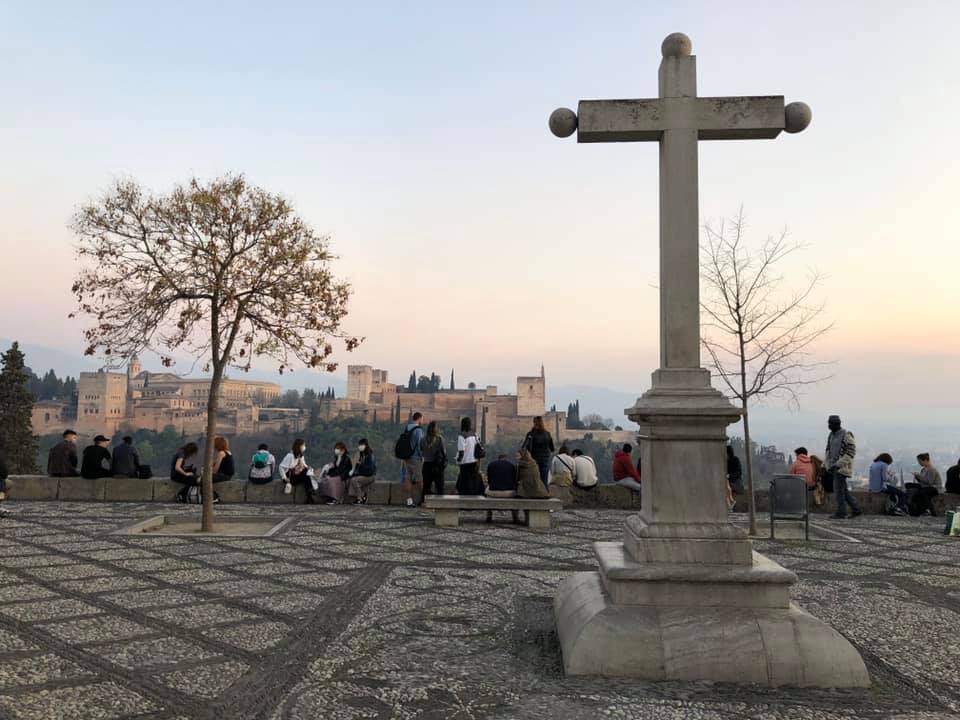
And surprisingly few people were out to watch the sunset turn the Alhambra crimson.
As the sun sank, I wandered aimlessly through the quiet, twisting medieval streets of Albaicín, the neighborhood I’d chosen to stay in. Everything was closed. At one plaza, from which I could see the Alhambra glowing in the sunset, a small crowd of twenty or thirty people had gathered, almost all of them young, taking selfies and chatting with each other. A sign of life at last — but nowhere near the crowds I was used to seeing on a Saturday night over the last few weeks. I walked back to the apartment feeling ill at ease. That night I cranked up the bedroom heat to ward off the chill I was feeling. I posted four photos to Facebook before going to sleep, titled “Ghost-town Granada.”
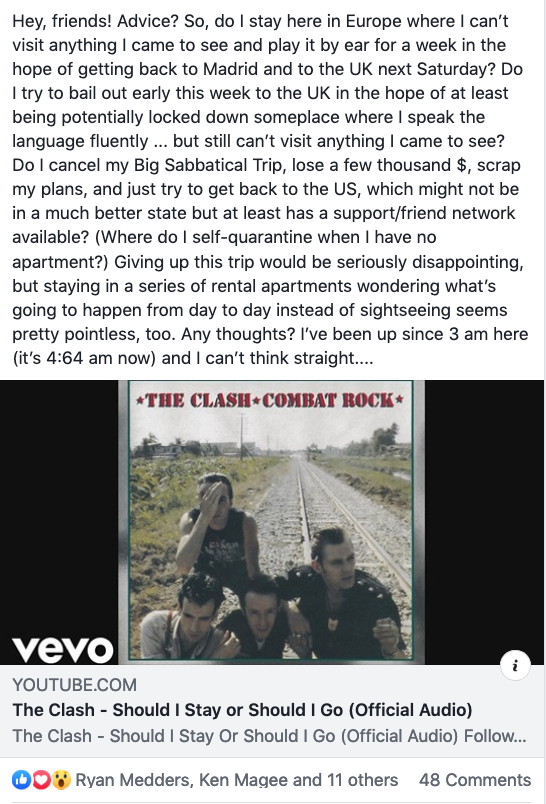 Sunday, March 15, 2020, Granada, Spain: I slept restlessly and woke up around 3 am. In a bad habit that had been developing over the last week, I reached for my phone to read the latest news. It wasn’t good: Spain was about to impose a public transport lockdown to take place on Monday. I felt sick. Did I want to stay here in Granada and try to continue my trip as planned? Did I want to risk getting locked down in this old, labyrinthine neighborhood, where the stores were already stripped, and I knew nobody? I sent off stressed emails to family and around 4:30 am posted a video to Facebook of The Clash’s “Should I Stay or Should I Go,” asking my friends for advice. I received a flood of comments back. Some said stay in Spain, where the health care was socialized. Others said come back to the U.S. while I still could. I went outside and restlessly paced the empty, foggy streets in my neighborhood again, wondering what to do.
While I was walking outside, weighing my alternatives, an email came in from a friend in London — “You’re welcome to occupy the guest room as long as you need,” he wrote. After a flurry of WhatsApp and Facebook messages back and forth with him and his wife, I made my decision — I’d leave. I went back to the apartment, booked a same-day train ticket back to Madrid, and a next-day flight to London. I called but couldn’t switch my March 20 booking at the airport-adjacent hotel in Madrid because I’d made it through Expedia … and Expedia had been impossible to reach for days as it dealt with panicking travelers. However, “just come on in when you get to Madrid,” the hotel receptionist said, adding a touch dryly, “We have plenty of rooms right now.” I texted the apartment landlord: “I have decided that it’s better for me to take a train back to Madrid today,” I wrote. I apologized for leaving food in the refrigerator. “Ingredients are unopened and untouched […] if you or anyone you know could use the food during the quarantine.” The landlord wished me well: “I do understand and I don’t know what to say … Strange situation. Take care of your self….” I already knew there wouldn’t be a refund for the days I wasn’t there.
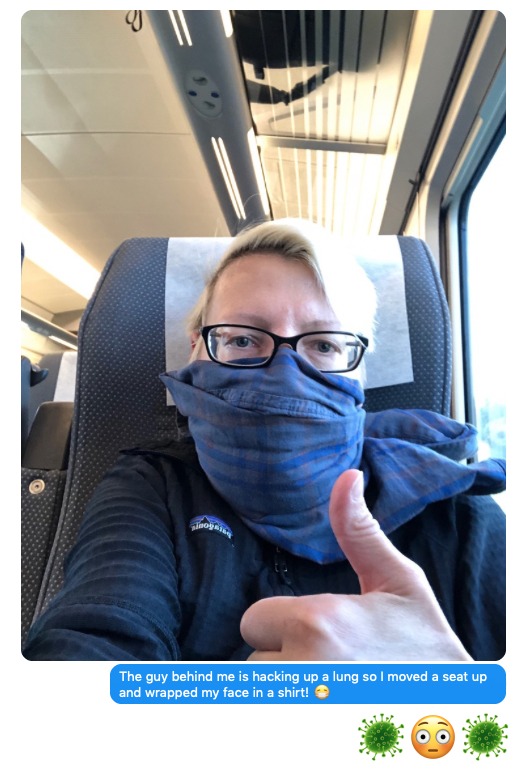
Texting to my sister on the train ride back to Madrid.
Not for the apartment in Granada, not for the apartment in Cordoba, and not for the two train tickets I wouldn’t be using.
Sunday’s express train back to Madrid contained a few more passengers than Saturday’s to Granada; people were still moving while they could, I assumed, before Spain’s stay-at-home order went into effect on Monday. In my panicked packing I’d shoved my scarf deep into my backpack, so I wrapped an extra shirt around my face instead, and when the passenger behind me started coughing, I quietly moved up a row to an empty seat.
A storm hung over Madrid, forming an almost too perfectly dramatic backdrop of flashing lightning and rolling thunder as I took a taxi to the hotel. Sure enough, there were plenty of rooms available. The hotel restaurant, like all restaurants in Spain, had been closed. Fortunately, I’d anticipated this and thrown some of the nonperishable groceries I’d bought the night before into an extra bag. Two-day-old bread, cheese, and chorizo was a spartan meal, but at least I had some dry cereal I could eat for breakfast, and one of those bottles of cheap wine I’d bought in Granada to help me go to sleep. Everything felt surreal.
Monday, March 16, 2020: Madrid, Spain & London, UK: Digital signs over the freeway to the Madrid airport reminded drivers that all non-essential travel was prohibited. Inside the nearly empty airport, regular announcements reminded us to stay two meters away from each other. I saw more people wearing masks now than I had before; maybe half of the travelers, and almost all of the airport employees. I was wearing one of the now-precious surgical masks I had picked up earlier in anticipation of my Saturday, March 21 flight to the UK. Well, today was only March 16, but it was clearly time to keep it on as I uneasily scooted away from other travelers and kept my eyes on the flight boards. A lot of flights had been canceled. Fortunately, my easyJet flight to London Gatwick wasn’t one of them.
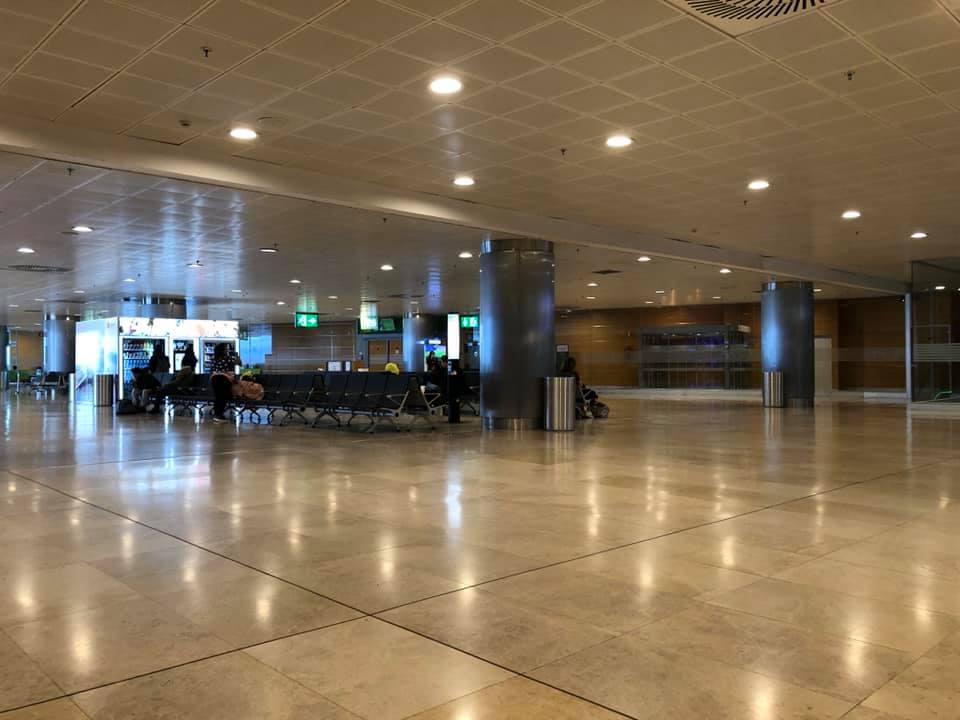
Announcements at the airport insisted we remain two meters apart.
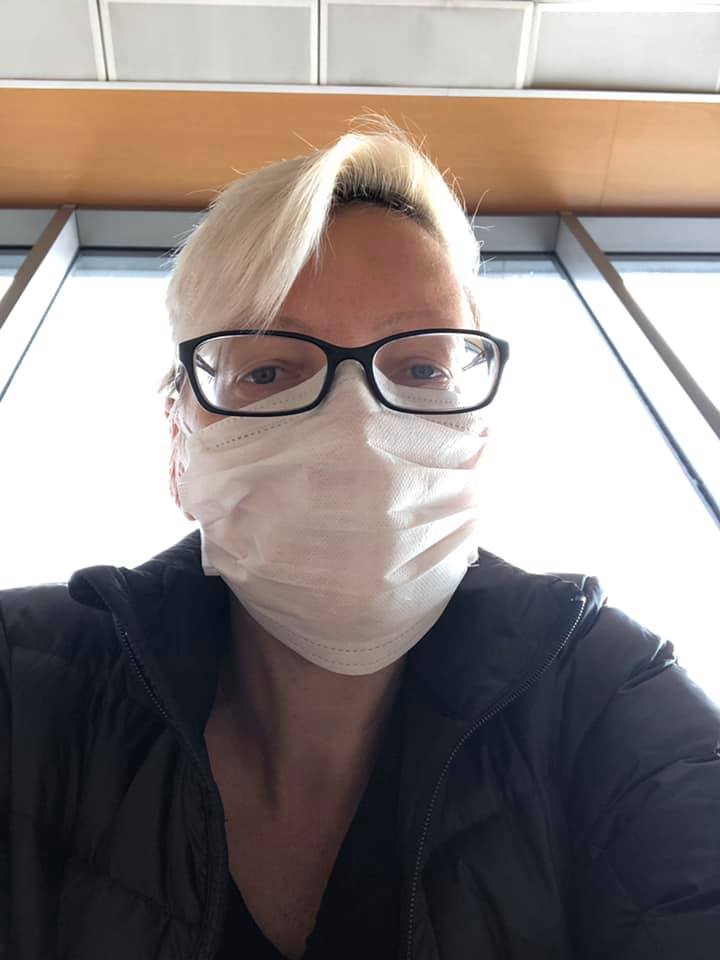
I wore a real mask on the flight from Madrid to London.
London felt like a breath of fresh air; almost nobody I saw was wearing a mask, restaurants were open, and the trains and Underground were bustling. I abruptly realized how oppressed I’d been feeling in Spain — I’d experienced a sense of starkness, of grim apprehension, in Spain over the last day or two that hadn’t yet settled over the UK. I texted to my sister, “It feels much less tense here; fewer people wearing masks, stores open, etc!” I kept my mask on, though, as I worked my way via public transportation to my friends’ flat, cognizant of the fact that I could be carrying the virus from Madrid.
However my friends DB and DD decided to trust in my health and allow me to unmask in their apartment. I could stay, they assured me, until my rental was available — I was supposed to be taking over my London apartment on Sunday, March 22 and stay there for two weeks. It was a generous and, given the circumstances, brave gesture.
However, that night it became clear that London, too, was seriously considering imposing restrictions. I struggled with myself a while and then decided to book a ticket to the Tower of London for the next day, Tuesday. Visiting the Tower was at the very top of my London to-do list. My two friends agreed: I should go while I still could. None of us knew how long anything was going to stay open.
Tuesday, March 17, 2020: London: My visit to the Tower was incredible — very few people were there at all. I was able to take photos of nearly empty courtyards and buildings, and meander my way around the crown jewels twice, asking questions of the warden in the room. I continued to wear my mask, though, out of consideration for others in the Tower’s enclosed spaces. One or two other tourists were doing the same, but most weren’t, and the Tower staff and guards weren’t. When I finally tore myself away, I ate lunch — hooray, the restaurants were still open! — and was about to hop the Underground to go to the Museum of Natural History — my number-two goal for London sightseeing — when I happened to check its website for the closing hours. It had closed due to the coronavirus just one hour before, and it would remain closed until further notice.
I felt the walls shrinking around me again.
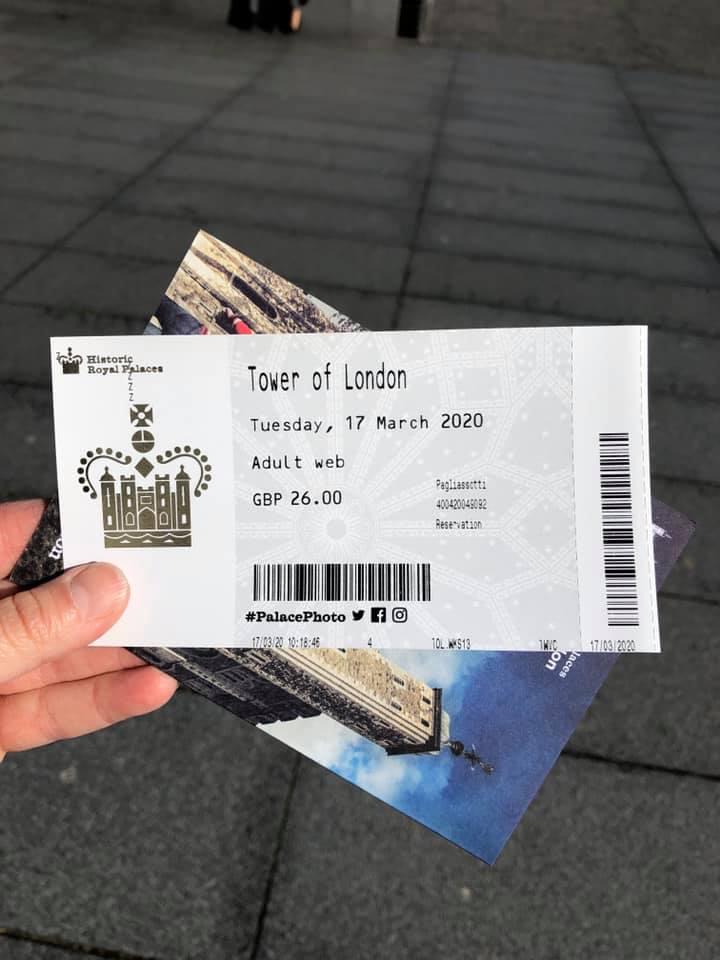
I was so happy to see the Tower at last!
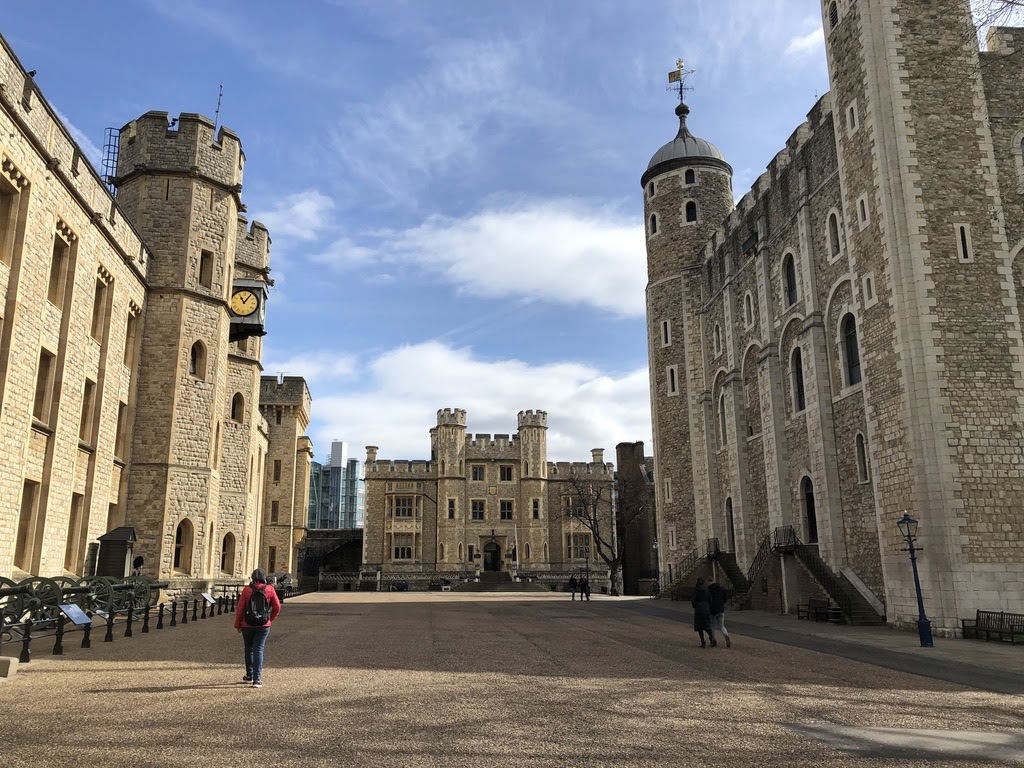
But almost nobody was there.
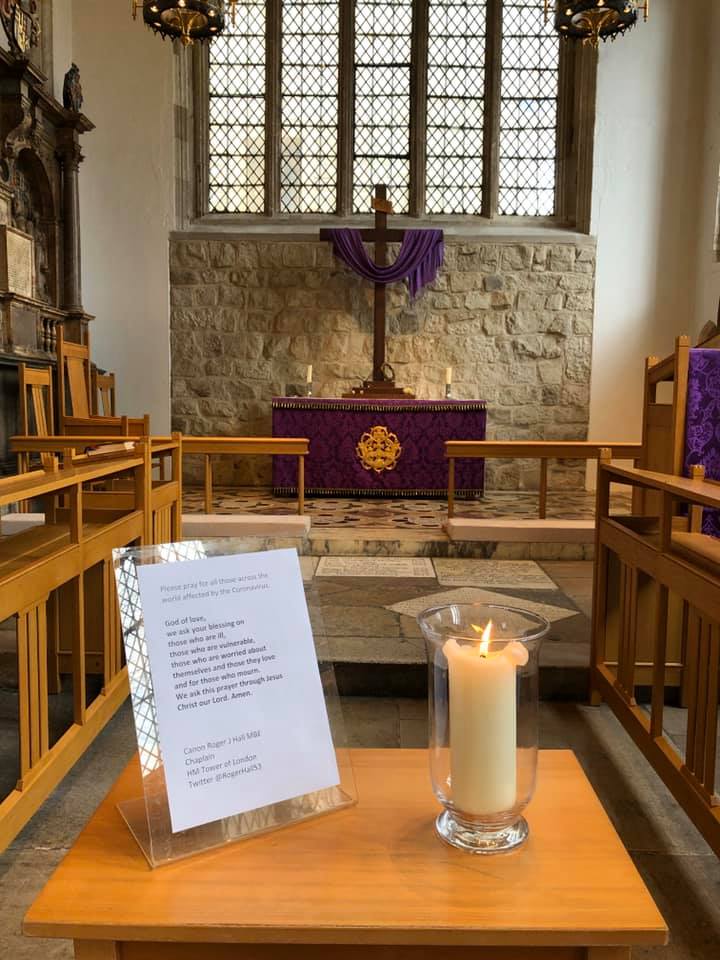
The Tower chapel displayed this prayer: “Please pray for all those across the world affected by the Coronavirus. God of love, we ask your blessing on those who are ill, those who are vulnerable, those who are worried about themselves and those they love and for those who mourn. We ask this prayer through Jesus Christ our Lord. Amen. Canon Roger J Hall MBE, Chaplain, HM Tower of London, Twitter @RogerHall53”
Wednesday, March 18, 2020: London: This was the day I should have been taking a train from Granada to Cordoba. Instead, I sat in the spare bedroom of my friends’ flat in London, FaceTiming with a friend from the US and fruitlessly trying to connect with Expedia to see what money I might get back from all those prebought tickets for sights, trains, hotel rooms, and flights that I clearly wasn’t going to use. But all I did was lose more money racking up data charges on my phone. ($110 worth, as I later found out.) None of the museums in London were open, but the markets and stores were, so one of my London hosts and I walked around a bit and had a drink up in The Shard, looking down on the Thames, St Paul’s Cathedral, and the Tower I’d visited the day before. I tried to encourage myself with the thought that I might be able to at least see the outside of the palaces, cathedrals, and museums I’d hoped to visit. And I was going to be in London for several weeks. Surely things would reopen soon….
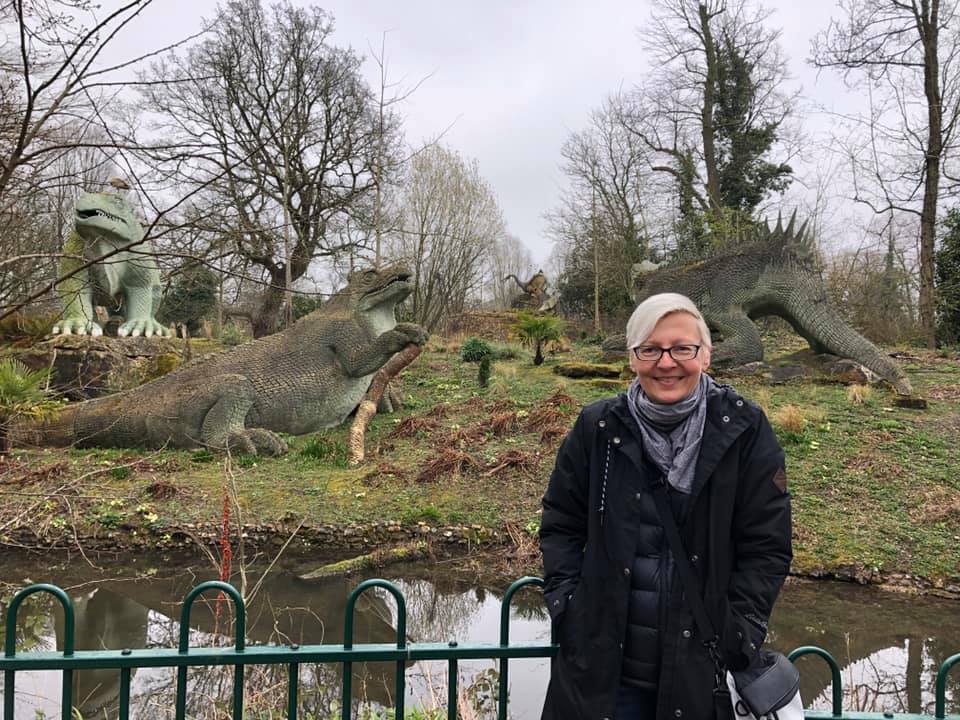
A kind stranger bravely risked the virus to take this photo for me, with the Crystal Palace dinosaurs behind.
Thursday, March 19, 2020: London: I took the train out of London to Crystal Palace Park. Seeing the old, chunky Victorian Crystal Palace dinosaur statues had been somewhat lower on my London to-do list, but the park had the benefit of being open and the statues of being outside. The day was drizzly and cold, and I kept a scarf wrapped around my face on the train again. The park wasn’t very crowded, and everybody was keeping well-distanced. Still, after taking a handful of unsatisfactory selfies, I asked a young woman if she’d take a photo of me with one of the bigger dinosaurs behind me. “Do you trust me to touch your phone?” she asked with a half-smile. “If you trust me to have a clean phone,” I countered with a shrug. “I guess it’s a mutual risk.” She took my photo for me. I thanked her, gratefully. We both, I’m sure, surreptitiously wiped off our hands and hoped for the best.
I had tried to be optimistic the day before, but on this grey and dismal day I decided it was time to face reality. I was officially on the #worstsabbaticalever, and it didn’t look like things were going to get better any time soon. What was the point of traveling if I’d be stuck in an apartment because everything around me was closed? I knew I wasn’t going to get a refund on my London rental, but I could start canceling everything else and get most of my money back. Some of my train tickets and flights would be nonrefundable, but the rental units were the biggest expenditures, and I was still in the full-refund window for them. I talked to family and decided to try to stay in London — so I could recoup some of the money already spent on the rental! — but fly back to the U.S. on April 1 instead of April 4 … giving myself a few days’ wiggle room in case a flight got canceled and I needed to have a place to stay as I rebooked. Resigned to my fate, I booked a flight out of London to Los Angeles on April 1 and wrote on Facebook, “Hi, friends and family! FYI, I have undertaken the Great Dismantling of my sabbatical plans and am currently booked to return to the States on April 1 for my 14-day quarantine.”
Then the U.S. State Department issued a Level 4 Travel Advisory.
I immediately began receiving urgent texts and Facebook posts: Come home! Christina Sanchez, CLU’s watchful associate provost for Global Engagement, WhatsApped and emailed me: “I strongly recommend you attempt to get a flight back to the USA immediately,” she advised. My friends and family agreed.
Friday, March 20, 2020: London to Los Angeles: Thank heavens for 24-hour flight cancellation policies. Early Friday morning I canceled the April 1 flight and booked a same-day, nonstop flight to LAX on Virgin Atlantic. This is why I have an emergency fund, I reassured myself as I eyeballed the ticket price and thought about how much money I was already losing. And if bailing back to the U.S. in the middle of a global pandemic isn’t an emergency, what is? Still, I flinched as I hit the “purchase” button. I hastily crammed everything into my backpack once again, thanked my friends for so kindly allowing me to stay with them, and raced off to take the Underground to London Heathrow, wearing a fresh surgical mask for safety.
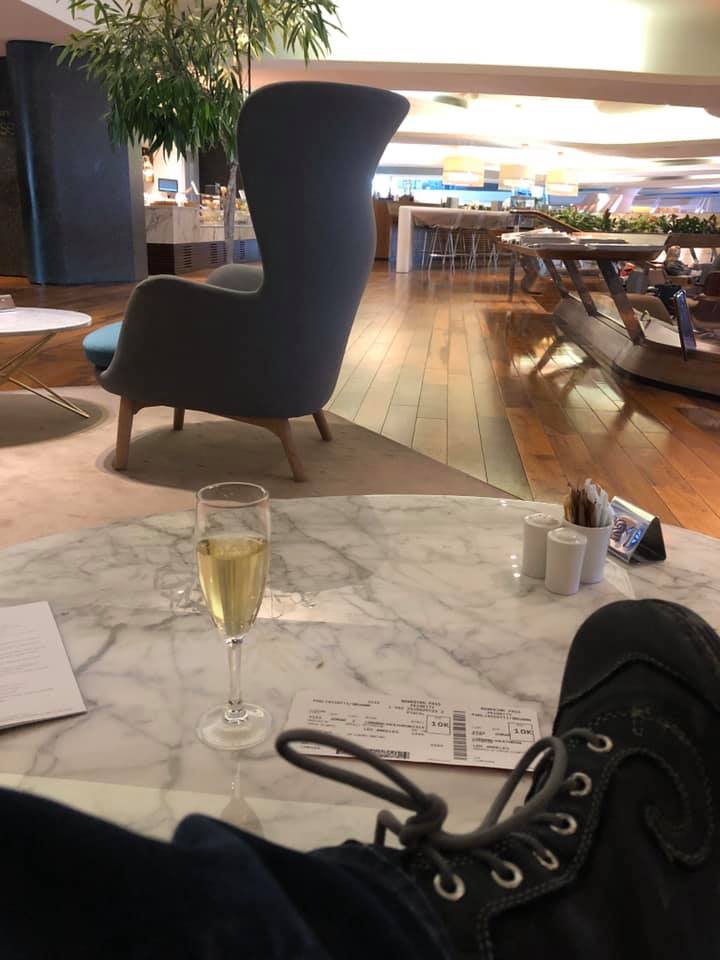
Emergency same-day flight in the midst of a raging global pandemic? Seemed like a good time to upgrade my seat and enjoy some free prosecco before the flight.
At Heathrow, I had to pick up my ticket from the airline counter. “So, any deals on an upgrade?” I inquired, remembering my friends’ Facebook photos of their flight a week ago. “As a matter of fact…” I was told. At that point I’d already lost so much money on my sabbatical that a little more didn’t seem to matter anymore — and what the heck, the world was apparently ending, anyway. Might as well go out in style. I handed over my credit card for business class. Good choice, I realize in retrospect. I was able to sit, well-isolated and well-fed (and -prosecco’d), in a comfortable lounge with excellent hand-washing facilities until my flight, and then stay about as far away from other people as possible in an airplane. Pandemic privilege.
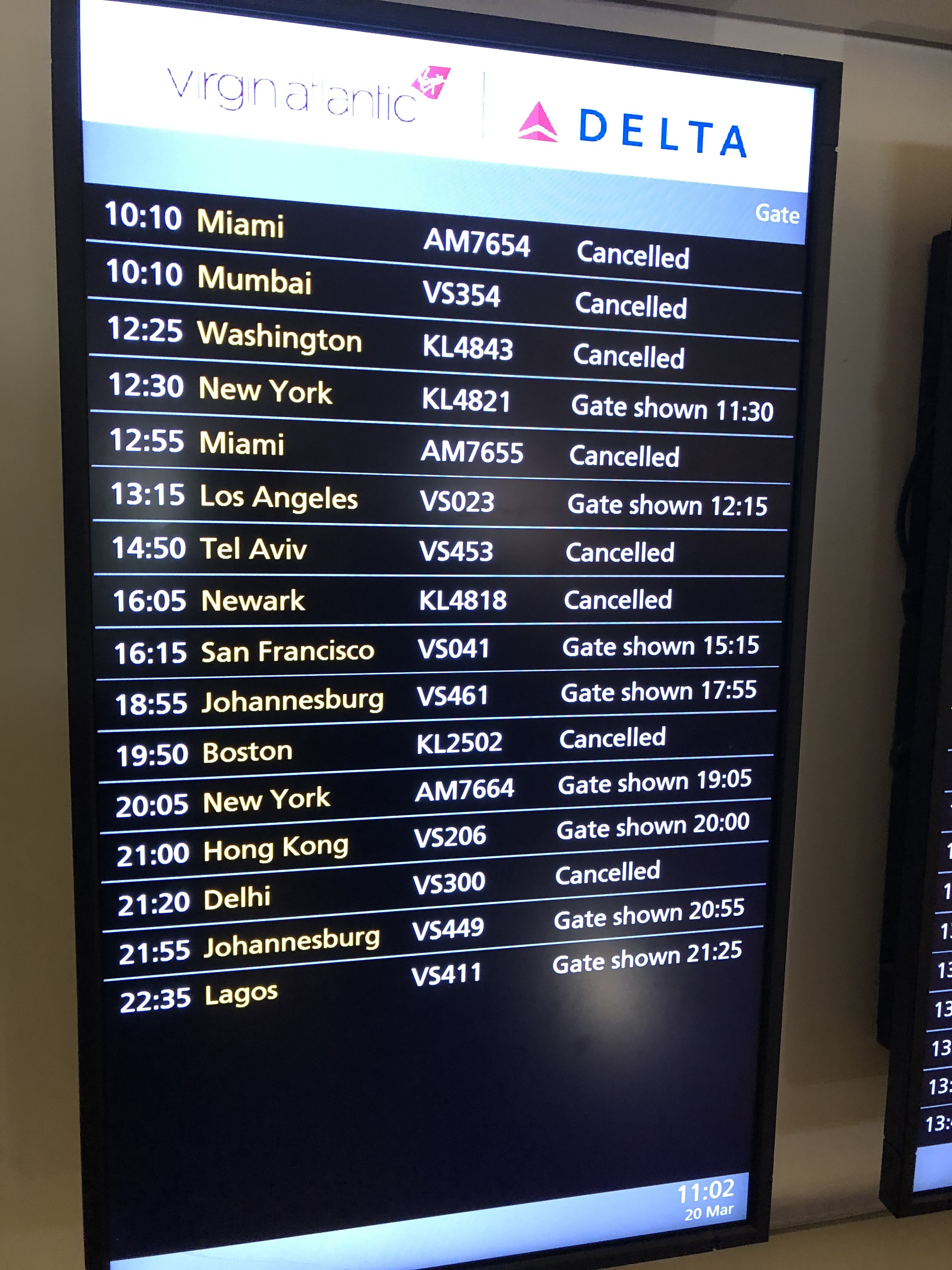
A lot of flights had been canceled. Fortunately, mine wasn’t one of them.
It wasn’t exactly a relaxing flight, though, as I was frantically purchasing and burning through airplane data-use plans while trying to find a place to quarantine upon arrival back in the States and arrange to get back my pickup from the friends who’d been looking after it in my absence. The friend I’d been FaceTiming with on Wednesday had suggested that CLU might be willing to put me up in an empty dorm room, since most of the student body had been sent home. Although the university couldn’t, in fact, accommodate me on campus, Christina Sanchez came through like a champion, suggesting alternatives, and while I was still in-flight our provost Leanne Neilson generously agreed to have her office book and reimburse me for a local hotel quarantine stay. I immediately sent the information to my friends and family, relieved. I had a place to stay when I got back that wouldn’t endanger any of them!
My experience getting through LAX was much easier than that of my friends who’d returned in the midst of the chaos of March 13th and 14th. Business class exited the plane first, and I was one of the first to step out. Passengers were escorted one by one to the line of plastic-shielded, respirator-wearing employees in the airport passage who asked questions about where we’d been and whether we were showing any symptoms of illness. I answered, was given a card about COVID-19 symptoms, and waved onward. That was it? I wondered. Global Entry was a breeze, as always, and all I had was my backpack, so I was out of the airport in about fifteen minutes. It took me longer to wait for the airport circuit bus that would take me to the parking lot where all the taxis and airport shuttles were now located!
I didn’t have any problem finding a Prime Time driver to take me to Moorpark, where I was going to get my pickup and drive it to the hotel where I’d be quarantined — but he wanted to be paid $90 in cash. The credit card machines are down, I was told by all of the drivers in the row. Were they? I don’t know. But I was very glad that before I’d left the U.S. back in February, I’d tucked a few $100 bills in the back of my passport holder for an emergency. I certainly never imagined that emergency would be a global pandemic … I’d been thinking more about my credit card being denied somewhere … but nevertheless I had the cash, so we were on our way.
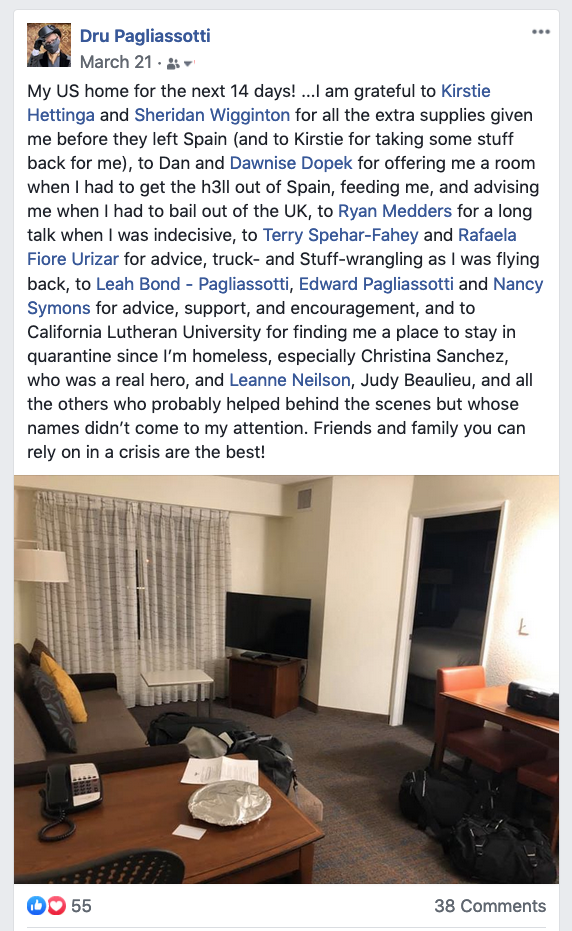 My 14 days in quarantine passed without any fevers or other signs of sickness, and I’m now ensconced with two more friends in Moorpark. I may be staying with them for quite some time, depending on how long this pandemic goes on and how badly the economy tanks. I’m very grateful for all of the generosity people have shown me as I bounced from place to place like a pinball for a week or two: the spare rooms, the advice, the hotel quarantine, the grocery runs, the encouragement, and everything else.
In many ways the experience of hurriedly leaving Europe and returning to the US in the midst of a pandemic reminds me of my experience with cancer back in 2015. Then, too, I had to make panicked decisions and often felt paralyzed by stress and uncertainty … and then too I was taken aback by the generosity and patience of the friends, family, and colleagues who helped me through surgery, chemotherapy, radiation, and physical therapy. During cancer treatment I learned to face my uncertain future with equanimity, accepting that the most I could do was to enjoy as much of each day as possible. I’m trying to maintain the same mindset now. I’ve been extremely lucky so far, and I can only hope that five years from now I’ll look back on this pandemic the way I currently look back on cancer — as a terrible time in my life that, nevertheless, affirmed the important things in life: family, friends, and taking a moment to appreciate each new day.
Good luck. Stay safe.
No comments
Comments feed for this article
Trackback link: https://blogs.callutheran.edu/paglia/the-week-the-walls-closed-in/trackback/