
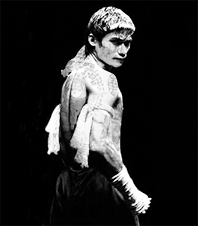
 After finally writing some Right of Rule the week before, I didn’t get anything written on it this week. Instead, I took a writing detour and started writing the backstory for a Dungeons & Dragons character I’m playing every month or two down in Van Nuys with a group of old college friends. When the game started, it was about the third game various members of that group had started, run briefly, and abandoned (the other two being Shadowrun & Star Wars, for any gamer geeks reading this). I was skeptical that the game would continue, so I put minimal effort into the character, writing a short three paragraphs — Tashi is a monk who was born into a northern mountains nomadic tribe, studied for ten years (from age 10-20) at a monastery, and has recently traveled down into the southern lands where the game was set with his staff and begging bowl. He’s rather striking-looking, with the entirety of his skin covered with inked sutras (I was inspired by Thailand’s Sak Yant tattooing and pushed it to the fantasy degree).
But the campaign’s been going on for a couple of years now, probably four or five times a year, and the weekend before last I spent some time with some enthusiastically creative middle-school girls who wanted to learn D&D and threw themselves head-first into backstory creation. I decided I’d better step up my own game and finally fill in the big blanks in my character’s past for the dungeonmaster to use and abuse. (Those backstories *always* come back to haunt you….!)
And as of this morning, I’ve written 26 pages of linked scenes from his past, LOL! Talk about going from nothing to a small novella.
Here’s the second scene I wrote. In the first, Tashi was six and at a sister’s sky burial. When he asks if having her body broken will hurt her, a monk takes him aside and tells him about the three traps of death (returning as undead, going to heaven or hell, and being reborn). Tashi’s culture is one in which death isn’t seen as something scary but is, instead, taken very seriously as a chance to reach nirvana. The monk encourages the little boy to be prepared for it. In the next scene, Tashi is eight and meets a mysterious character who will keep dropping in and out of his life up until the point where he leaves his own land and travels south. I have borrowed liberally from Tibetan culture (AD&D just calls the peoples of these mountains “snow barbarians”; yuck! The game, especially in its earliest forms, wasn’t too progressive) but of course changed it to fit the fantasy culture of D&D. More caveats — its just gamer writing, not “serious” writing, so I’m not trying to make it novel-quality….
***
Early winter storms had already covered the ground with snow by the time the Nahm-Ka reached their winter settling grounds. Another storm greeted them as they entered the valley, blowing sleet and snow into their eyes, so that they didn’t linger but quickly broke into family groups to seek out their closed-up homes. While his mother and Tsundue started the hearth fires in their winter home, Tashi stayed outside with his two older brothers, struggling against the biting sleet to secure the family’s yaks in their stone enclosure. They’d been hearing the winter wolves howl for hours, which hadn’t been so bad when they’d been with the rest of the clan, but now that everyone had separated, the sound was more frightening. Tashi’s oldest brother, fourteen-year-old Tenzin, told him at least the howling meant that there weren’t any ice wyrms around. Wolves were a lot easier to kill than remhoraz.
“Ice wyrms don’t come this far south,” his ten-year-old brother Norbu objected. Tenzin shrugged and grinned at him. Tashi relaxed. Tenzin was only teasing, then, trying to scare them.
Their father and the other clan warriors had left a few hours ago to make sure the monks and their staff reached the gompa, the cliff monastery, safely. With Mother in the house, Tenzin was in charge, which irritated Norbu no end, although Tashi didn’t mind. As the youngest, smallest child, he was used to being bossed around.
Suddenly a new note rose over the howling of wind and wolf — the deep, gasping sound of the dung dkar, or conch horn. Tashi looked up, his eyes wide. Next to him, their mastiff, Ketu, growled.
“They can’t be calling us to worship now, can they?” Norbu asked, hanging off the gate wooden.
“It must be an alarm.” Their oldest brother, Tenzin, slapped the last yak on the hindquarters, urging it into the enclosure. “I’ll go find out what’s happening.”
Ketu’s growling grew louder and he turned to face the whirling snow and darkness, his thick collar standing on end. The howling wolves suddenly fell silent.
“Shit.” Tenzin grabbed the heavy hunting spear he’d left propped by the enclosure. “Norbu, take the lantern.”
Norbu snatched it up, holding it out a full arm’s length.
“I don’t see anything!” he said with a quavering voice.
“Shhh!”
Tashi held his breath as his brothers fell silent. Ketu took a few stiff steps farther out in the snow, teeth bared. Behind them, the yaks grunted and moved restlessly in the stone enclosure.
“Quiet them, Tashi,” Tenzin ordered. Tashi obediently slipped through the gate slats and threw his arms around the closest yak.
“Hush,” he whispered in its nervously flicking ear. “Don’t move.”
The giant animals paid no attention, shifting back and forth. Tashi moved from one to the other, trying to calm them. Ice wyrms hunted by vibration, he knew from the hunters’ tales, so it was important to keep the yaks from moving too much.
A distant scream pierced the air.
“Come on!” Tenzin began running, spear in hand, and Norbu scrambled behind him with the lantern.
“Wait for me!” Tashi shouted, pushing his way through the yaks. But by the time he reached the gate, his brothers had vanished into the darkness. Sleet stung his eyes and the wind sent snow swirling up around him. “Tenzin? Norbu?”
He could barely hear Ketu barking over the wind, and the long, mournful intonation of the dung dkar.
He clutched the wooden slates of the gate with his gloved hands as he stared blankly into the darkness. They left me! He hated it when they did that.
“Stupid brothers,” he muttered. “I’m going home, then.” He couldn’t see anything, but his house wasn’t that far away; just straight across the pasture where the yaks grazed during the day. From the enclosure gate, all Tashi had to do was keep walking straight, and he’d end up safely back home, where his mother and sister would be waiting for him by a crackling fire with hot butter tea and tsampa. Let Tenzin and Norbu run around in the dark and the cold; he’d be warm and comfortable!
He drew in a deep breath and slipped through the slats again.
Straight across. Easy. He began walking, his hands held out in front of him even though he knew there was nothing to run into until he reached the house. The wind pushed against him as if trying to send him the wrong way and he pushed back, determined not to be fooled. Just put one foot in front of the other, he encouraged himself. Mother will have a lamp in the window.
He wasn’t sure how long he’d walked when he finally tripped over a stone and fell into the snow. He pushed himself up, turning his head blindly. There was no light to be seen at all.
“Tsundue?” he shouted. “Mother?”
There was no answer. Tashi stood, brushing the snow off his fur-lined pants and jacket.
I’m lost, he decided. He stood still, listening. Still no more howling. Or screams. Just the wind, and creaking trees, and the snow crunching under his feet.
I’m alone, he thought, amazed. He brightened. I’m alone!
He’d thought a lot about what the monk had said last year, when his sister had died — that everyone should practice for the day that they had to face their death alone. He’d wondered how he could practice, because he was never alone. But here he was, all by himself. He smiled into the darkness and the snow.
It’s just like being dead!
He squatted and scraped at the snow until he found some grass. Holding it up in his gloved hand, he focused. The grass burst into flame and was immediately blown out by the wind.
Oh.
He lit another clump of grass. It immediately went out, too.
A chill ran down his back. The bardo wasn’t supposed to work like that, he thought. It wasn’t supposed to extinguish his hard-earned efforts so easily.
He looked up into the darkness, feeling the cold wind on his face and the chill seeping around the cuffs of his jacket and pants, too. He remembered his father telling him and his brothers how to dig into the snow if they were ever on their own and needed shelter.
But if you rest while you’re in the bardo, you wake up without any memories and get born again, he thought. That was no good. He didn’t want to be reborn; he wanted to find nirvana.
He stood and began walking again. Better to be tired and cold and keep moving than to stop to sleep and lose everything, he told himself.
He was starting to lose the feeling in his face and hands when he finally saw a glimmer of light. He fixed his eyes on it and started to run, but his feet felt heavy and clumsy.
“Nirvana!” he shouted. “Nirvana! Wait for me!”
To his relief, the light began to move toward him. He waved both arms, stumbling through the snow.
The glow finally resolved into an eerie blue light limning a gnarled staff of pieced-together bone and antler, held by a pale hand. Tashi stopped, startled, as its wielder materialized through the whirling snow. She was a thin stranger wearing nothing but a tattered monk’s robe, her flesh defiantly bared to the winter’s wind. Bone and horn beads were braided in her long, pale hair, and although her skin was tattooed like all monks’, the letters were strange, unlike any others Tashi had ever seen. A carved conch-shell dung dkar hung from her belt, next to a silver-and-turquoise inlaid kapala, a skullcup.
“Well, well,” she said, regarding him with interest. “What have we here?”
She wasn’t nirvana. He didn’t think so, anyway.
Tashi pulled himself together and gave her a cautious bow.
“Are you a god or a demon?” he asked.
She cocked her head. He couldn’t tell how old she was; her face wore weathered wrinkles around the eyes and mouth, but her flesh still seemed firm and strong.
“Neither, yet,” she replied. “And you?”
He shook his head. “I’m Nahm-Ka,” he said. And then, cautiously, “but I might be dead.”
“Really? So young?”
“I’m eight.”
“Hmm. A bit young for my taste, even if you are dead.” She held out a hand. “We’d better walk together for a while.”
“I’m not supposed to talk to gods or demons,” he said, solemnly. “Or mothers.”
“Well, I’m not any one of those things, so you’re safe.”
Reassured, he stepped forward and took her hand. She leaned down and sniffed him.
“I’m sorry to tell you this, child,” she said with an air of regret, “but you’re still alive. For the time being.”
“Oh.” If he wasn’t dead, then he supposed he wasn’t in the bardo. That must mean he was still in the winter valley. “Are you a monk? Are you going to the gompa?”
“Yes, I am, and no, I am not. I knocked on the monastery door a little earlier tonight, but nobody would let me in.” She began walking, still holding Tashi’s hand.
“Why not?” he asked, looking up at her.
“We have some differences of opinion, your order and I. So I had to take what I wanted from your village, instead.”
“If you need a place to spend the night, Mother would let you sleep by the fire,” Tashi volunteered.
“Would she? How many are at home besides your mother?”
“Just her and my sister,” Tashi said. “Father and my brothers are out here. Somewhere.” He looked around. “They might be lost, too.”
“I see.” She gave him a sidelong glance. “Let’s not bother your mother, then. What’s your name?”
“Tashi.”
She nodded slightly. “An auspicious name, Tashi. I’m called Yeshi Vetali.”
“Vetali?” Tashi stopped in his tracks, staring up at her. “That’s a monster name!”
“Is it?” she asked, mildly. “Then I must be a monster.”
A monster! Not a god or a demon, but a monster. Tashi frowned. That wasn’t fair. The monk hadn’t warned him that there would be monsters in the bardo.
But he wasn’t in the bardo, was he? He was still in the valley. He looked around, confused. For the first time, he noticed that there were other shapes moving around them, silent silhouettes barely visible in the limited light of her staff. They walked strangely, not like animals but not like people, either.
“Who’s that?” he asked.
“More monsters. Would you like to see?”
Would he? Tashi hesitated, then nodded. If I can see them, he reasoned, they can’t grab me from the dark.
Yeshi Vetali called out in a strange language. In response, seven of Tashi’s neighbors staggered into the circle of light, men and women he’d known all his life — except, as he looked into their eyes, he knew at once that the people he’d grown up with were gone.
Then his father stepped into the light, the eighth of the group. For a moment Tashi started to call out to him, excited, but then — then he saw his father’s eyes.
His father was gone, as well.
“They aren’t monsters,” he said, crushed. “They’re just dead.”
“Undead,” Yeshi Vetali corrected. “And therefore they are, too, monsters.”
“No, they’re not. That’s my father,” he said, pointing. “And those are my neighbors.”
The monk regarded his father’s corpse thoughtfully, then looked down at Tashi.
“No, child,” she said. “Not anymore.”
Tashi stared at her a moment, his thoughts feeling sluggish, and then abruptly understood.
“They’re in the bardo?”
“Yes. Rather freshly so, I’m afraid. Sorry about your father, child. Wrong place, wrong time.”
He stared at her. She turned him around, facing him toward his father’s body again.
“Say goodbye.”
Tashi took a step forward, hesitated, and then forced himself to take another, until he was standing in front of his father’s corpse. It swayed slightly, stiff-kneed, its vacant eyes fixed on some point in space. Tashi stared at it, feeling a familiar sense of loss pierce him, the same loss he’d felt when he’d finally realized, really and truly realized, that Dema was never coming back. He pulled off his glove and reached out to touch his father’s hand with his bare fingers.
His father’s flesh was already cold.
Somehow, that made it easier.
“You’re supposed to break the bodies,” he said, looking over his shoulder. “That way the spirits know they can’t come back.”
“They can’t come back, anyway,” she replied. “But don’t worry. These bodies will be broken soon enough.”
“When?”
“Oh, within a few months, I expect. Depends on what my enemies have in store for me.”
Tashi turned back to his father, or rather, the rolang that had been his father. He wished he were a rogyapa, or maybe even just a few years older and a few feet bigger, like Tenzin, so that he could grab his father’s body and run away with it, take it up to the burial site and make sure it was safely eaten away by the vultures. But he wasn’t, and he knew there was no point wishing otherwise.
“If you’re still watching, Papa,” he said, softly, “it’s time to go. Don’t listen to any gods or demons and don’t sit down to rest anywhere. Just keep walking and walking until you reach nirvana.”
The corpse swayed back and forth a little. Tashi turned and trudged back.
“You aren’t afraid?” the monk asked as he rejoined her. He shook his head. “Why not?”
“They’re my friends and family,” he said, simply. “And you said you wouldn’t hurt me.”
“I might have lied. I am a monster, after all.”
He looked into her face, but despite her words, he didn’t see any threat in her expression; just curiosity.
“Well, either you aren’t going to hurt me, or you’re going to kill me and turn me into a monster, too,” he said at last. “If you kill me, that’s all right. I’ve been practicing to die.”
She gave a bark of laughter. “Have you? Good boy. Very farsighted. Practice makes perfect. Come along.”
She left him outside the Rabgyals’ house. When he knocked on the door, the family greeted him with exclamations and brought him close to the fire to warm himself. He’d seen their daughter Pema among Yeshi Vetali’s rolangs, but he didn’t say anything to them, because he knew it would only make them sad. Nor did he say anything the next day, when he returned home to be greeted and scolded by his mother and his older sister and brothers, all of whom had come home safely at last. Nor did he say anything when his clan finally realized that eight of its warriors, including his father, were missing, lost in the storm on their way down from the monastery. The village held on to hope for a few more weeks, but then finally accepted the inevitable. The monks chanted for two full days, and Tashi hoped that wherever his father’s spirit was, he would hear the chanting and be comforted.
***
So far I’ve written scenes taking Tashi up to age 17; I need to get him to 20. Right now I’m trying to decide how he leaves his monastery. With Yeshi Vetali feeding him a perspective over the years that his own monkish order doesn’t much agree with — that undeath is a perfectly acceptable alternative — he may end up leaving in disgrace. Not that he consciously chooses to do something terrible, but he’s rather trusting, and he doesn’t always think things through very carefully. Not to mention being immersed in a philosophy in which good and evil are seen primarily as mental concepts unrelated to reality. (Tashi’s true neutral in alignment, for the D&D geeks.) However he leaves won’t affect where we are in the game right now, since he’s so far from home, but it’ll give the dungeonmaster hooks that he can choose to exploit or not. I expect Yeshi Vetali will still be around by the time I finish the scenes … she’s a necromancer at best and undead herself at worst … for the DM to use if desired, and probably a few of Tashi’s monastery-mates, who may or may not have a grudge against him. We’ll see!
It’s been fun writing something different. With luck I’ll come back to Right of Rule refreshed after putting myself into a different kind of character’s headspace for a while.
No comments
Comments feed for this article
Trackback link: https://blogs.callutheran.edu/paglia/writing-detour/trackback/