
The Work of Democracy: Reflections from the ICMA Annual Conference

  • Written by Julia Soares

What does it take to keep a society running? It’s a question most of us rarely stop to consider until something goes wrong. We expect grocery stores to have blueberries in stock, our trash to be picked up on time, and our streets to be maintained. It is only when something breaks down that we begin to appreciate how many people, decisions, and systems have to come together to make everyday life possible.
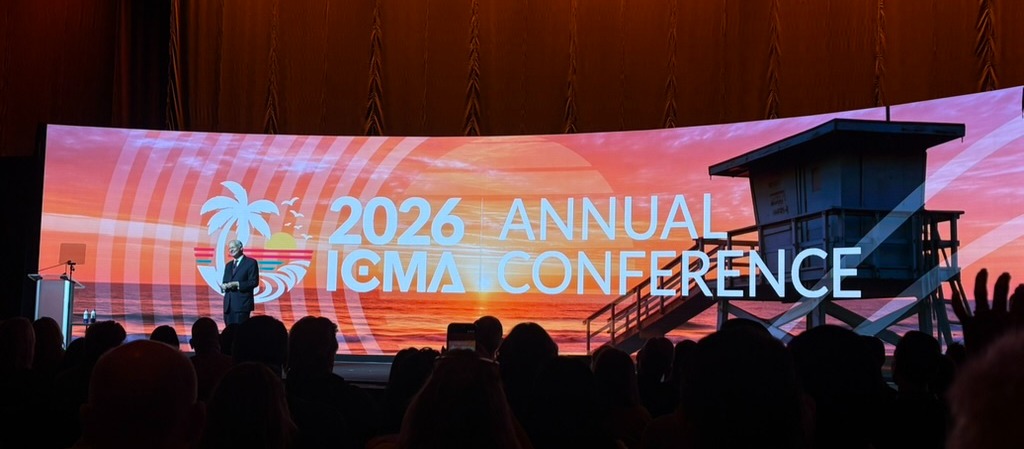
This idea stayed with me after attending the International City/County Management Association (ICMA) Annual Conference in Long Beach, where city managers and local government leaders gathered for several days of seminars, conversations, and opportunities to learn from one another. As a Master of Public Policy and Administration (MPPA) student, I was interested in hearing how leaders approach the challenges facing their communities. But a common theme emerged across the conference, particularly in the keynote addresses from Simon Sinek and Jon Meacham: the importance of curiosity, humility, and a willingness to keep learning.

These qualities are not just useful for individual leaders. They are essential to building effective institutions, navigating disagreement, and sustaining democracy itself.

Culture by Design, Not by Default

Simon Sinek is a popular author and inspirational speaker on business leadership, known for his books Start with Why and Leaders Eat Last. In his Fireside Chat on stage at ICMA, he emphasized that we have a choice between creating a culture by design or allowing one to develop by default. If we do not actively shape the cultures we work and live in, they will shape themselves, and not necessarily in ways that serve us well.

For local government leaders, organizational culture influences how employees communicate, approach problems, and respond to change. A culture that discourages questions can make it difficult to adapt, while one that encourages curiosity creates room for people to identify problems and work toward solutions.

Sinek highlighted curiosity and humility as two of the most important human skills in leadership. These are qualities we often discuss in the context of personal relationships and effective communication, yet they are just as important in professional settings and public service.

Curiosity requires us to ask questions before making assumptions (judgment does the opposite). When we decide we already understand someone or their perspective, we begin labeling rather than listening. Humility reminds us that none of us has all the answers, regardless of our position or experience. Good leaders recognize what they do not know, seek out different perspectives, and remain open to changing their minds. 

For public servants, these skills are especially valuable. Local governments serve communities with different experiences, needs, and priorities. There is rarely a single solution that works for everyone. Curiosity allows leaders to understand those differences rather than make assumptions about what their communities need.

Disagreement Is Not the Same as Division

Meacham, Pulitzer Prize-winning biographer, historian, and bestselling author known for his work on American history and political leadership, connected these ideas to the broader challenge of sustaining democracy. He noted that the United States has long been closely divided politically, with almost every presidential election since our inception coming down to something resembling a 49/51 split. Disagreement is not new to American democracy, nor is it inherently a problem. A democratic society depends on people being able to hold different views, debate ideas, and challenge those in power.

The danger comes when we stop seeing those with whom we disagree as fellow citizens and begin treating them as enemies. An adversary is someone whose position we oppose. An enemy is someone we believe must be destroyed. Those are fundamentally different ways of approaching disagreement. Democracy requires us to coexist with people whose views may differ significantly from our own. When every disagreement becomes a battle between people who believe the other side has no legitimate place in society, there is little room left for compromise or collective problem-solving.

This is where curiosity becomes more than a leadership tool. It becomes a civic responsibility. We do not have to agree with someone to try to understand their perspective. Listening does not mean surrendering our principles, just as seeking common ground does not mean abandoning our values. Meacham reflected on the difficulty of loving one’s neighbor. It is a familiar lesson, but one that remains remarkably difficult to put into practice. If treating others with compassion came naturally, perhaps we would not need to be reminded to do it so often.

For local government leaders, this challenge plays out every day as they work with residents, colleagues, and elected officials who may have very different ideas about what their communities need. The ability to listen, remain open to new information, and work through disagreement is essential to serving the public effectively.

A More Perfect Union

One of my favorite takeaways from the conference came from a conversation with my friend and classmate Jharie, who is originally from the Philippines. Having experienced government in a different national context, she brought a perspective that reminded me not to take the everyday functioning of our public institutions for granted. As we left the conference together, she shared how encouraged she was to see so many people genuinely committed to improving their communities and finding ways to serve the public better. It struck me that, despite the challenges facing our democracy, there is something meaningful about having people who continue to show up, ask questions, and work toward something better.

Her perspective gave me a reason to step back and appreciate something that can be easy to overlook. At a time when political discourse can feel overwhelmingly divisive, local government professionals had gathered in Long Beach to learn from one another, discuss difficult challenges, and explore ways to serve their communities more effectively.

Of course, our institutions do not always work as they should, and there is no shortage of problems to solve. But the willingness to acknowledge those shortcomings and work toward solutions is important in itself. The United States was founded on the aspiration to form a “more perfect Union.” This aspiration acknowledges that in some ways, our institutions will fall short, our communities will face new challenges, and we will inevitably disagree about how to move forward. But we can learn, ask better questions, listen more carefully, and recognize that our own perspective is never the only one worth considering.

Just like the theory behind “pothole politics,” which emphasizes the importance of focusing on the everyday services people rely on and delivering them well, sometimes the solutions are right in front of us. New York City Mayor Mamdani recently took this idea literally with his “Pothole Blitz”, by mobilizing the Department of Transportation crews to complete a week worth of repairs in just one day. While filling potholes might seem simple, it was a way he could signal to his constituents that he was listening and wanted to make a tangible difference in their lives by prioritizing the basics. In a political climate often dominated by partisan divisions and big promises, consistently delivering the everyday services people depend on is one way local governments can demonstrate their value and rebuild public trust.

As an MPPA student, I left the conference thinking about how these lessons apply not only to the people who manage our cities and counties, but to anyone who wants to contribute to public life. Curiosity helps us understand the systems we depend on, humility reminds us that there is always more to learn, and a willingness to engage with people who think differently keeps the door open to progress.

Democracy is not a finished product. Neither is leadership, nor the work of building a community where people can thrive. Success is not about reaching a point where nothing needs to change. It is about continuing to show up, learn from one another, and make things a little better than they were yesterday.

Student Highlight: Noelle Martinez –

  • Profile written by Julia Soares

Before Noelle Martinez enrolled in Cal Lutheran’s Master of Public Policy and Administration (MPPA) program, she spent years on the advocacy side of public life, working in civil liberties, labor organizing, and attended law school. Those experiences taught her a great deal, but they also led her to a question that changed her career path: what would it look like to work toward solutions that serve different communities equitably, rather than advocating for one side?

From Organizing to Administration

Noelle worked as a labor organizer for SEIU Local 99, which represents classified education workers in school districts across Southern California. For about a year, she helped organize and mobilize Los Angeles Unified School District workers as contract negotiations stalled and a strike became a real possibility.

The experience put her in an uncomfortable spot. Organizers were telling workers that the District could afford raises, while the District insisted it could not. “I started asking myself, ‘What if they actually don’t have the money?'” she recalls. An open-ended strike could mean weeks without a paycheck for people already struggling financially, and she wanted to understand what was happening on the other side of the table.

“Workers were fighting for their livelihoods and wages they could actually live on, but the District also had a responsibility to maintain its financial health and manage all of the other demands on its budget,” she says. That tension, and how public institutions make hard decisions when no option makes everyone happy, pushed her toward public policy and administration. She wanted to learn how those decisions are made from the inside and how to make them equitably, especially for low-income communities and communities of color.

Finding Community at CLU

Noelle began the MPPA program in May 2026 and is finishing her second term. What has surprised her most is how supportive the program has been. “I’ve felt really supported by the MPPA program not just as a student, but also as a professional and as a person,” she says, adding that she already feels she has grown a great deal.

She has also taken full advantage of the opportunities to get involved. Noelle serves as the MPPA representative for the Graduate and Professional Student Council (GPSC) and recently became Vice President of the ICMA Student Chapter. She sees these roles as ways to build relationships with peers, professors, and the wider CLU community, and to learn about leadership and bringing people together. She is especially excited to help students who are just starting the program find their footing.

Her advice for fellow students is simple: “Sometimes all it takes is being willing to put yourself out there.”

Public Service From the Inside

Noelle is putting her classroom learning into practice as an AmeriCorps fellow with the City of Moorpark. Based in the City Manager’s Office, she has been exposed to many parts of local government, including economic development, community engagement, risk management, and communications. She also helps coordinate the City’s Teen Council.

The fellowship appealed to her because it offered hands-on experience while she works toward her degree. She values seeing how decisions are made and carried out at the local level, and how closely local government is tied to the people it serves. “I get to see how public administration and the things I’m learning in the classroom actually play out in real life,” she says.

One of her main interests is community connection. Noelle observes that division today runs not only through politics but through neighborhoods, with many people feeling little attachment to the places where they live. She wants to learn how local governments can use their tools and resources to build that sense of belonging. “It is the level of government that is closest to people’s everyday lives,” she notes, which puts it in a unique position to bring people together.

A Grassroots Approach to What’s Next

Noelle describes herself as “a very grassroots-oriented person,” and her organizing background shapes everything she does. Organizing taught her to begin by listening to what people actually want and need instead of assuming she knows what is best. She wants communities at the center of the decisions governments make, and she is committed to making sure every voice is heard, not just the loudest ones or the majority.

Over the next couple of years, she plans to build practical skills in policy analysis, budgeting, community engagement, and project management, and to keep learning from the people around her. Public service, she has found, cannot be fully understood from a textbook, and pairing coursework with real-world experience has been especially valuable.

Her larger goal is to help make the government more equitable and representative. She believes that people from historically excluded communities should be present in policy conversations and among those making and implementing decisions. “I hope to continue developing the skills to advocate for that representation, bring different voices into the decision making process, and help build public institutions that work for everyone,” she says. Based on her first two terms, Noelle is well on her way.

A Liberal Arts Foundation for Public Service? What my Maxwell School education taught me about “liberal arts” and a “technical education” – Dr.Sabith Khan

wikilovesmonuments.us

During our inaugural Fall retreat for the faculty this year, the opening theme was focused around the theme of “Future ready graduate: Skills, values and community impact.” The discussion had a strong focus on the relevance of a liberal arts education in the US and how it is relevant to the world we live in.

This issue of relevance of education and return on investment has been at the heart of a technical education vs. humanities debate, which is part of the larger debate about the value of Higher ed in today’s world. My own journey to academia and social sciences (aligned with liberal arts and interdisciplinary work) has been circuitous and begins with a very technical field.

I graduated with a bachelors in Engineering, though had a knack for writing and communications. Soon after graduating, I jumped head on, starting my own communications consulting firm and subsequently working for Ogilvy & Mather in their PR unit for a while. This led to other opportunities in other firms and eventually, I made it to the Maxwell School of Syracuse University for an MPA and MA in International Relations.

I applied for just three programs, while I was working in the Middle East, ranked #1, #2 and #3, respectively – they were Maxwell School at Syracuse Uni, Harvard Kennedy School at Columbia and the school at Columbia Uni. I got accepted to Maxwell, with a scholarship! The decision was made for me. Why did I choose to come here?

It was largely becasue at the heart of Syracuse University’s Maxwell School of Citizenship and Public Affairs lies a distinctive educational philosophy: the belief that professional training in public policy and administration is most powerful when rooted in the liberal arts. This approach, which integrates professional MPA and other technical programs with interdisciplinary social science, produces graduates who are not merely skilled technicians but engaged citizens equipped to tackle complex societal challenges. I was enrolled in a dual MPA-MA(IR) focus so needed strong foundational courses in social sciences, that Maxwel school provided.

The Maxwell School, established in 1924, was founded on the principle of teaching citizenship to all Syracuse undergraduates. This commitment to civic engagement remains central to its identity, distinguishing it from traditional professional schools. I had the most intellectually stimulating time of my adult life at Maxwell School, where I was a Graduate Assistant at the Moynihan Institute and worked with one of the foremost experts on Iran, Dr. Mehrzad Boroujerdi.

As the only graduate school whose professional programs in public administration and international affairs are fully integrated with social science departments, Maxwell offers a truly distinctive educational model. Its faculty of 170 scholars across six social science disciplines: anthropology, economics, geography, history, political science, and sociology; provide students with multiple lenses through which to understand policy problems. I attended classes in many of these disciplines as the elective structures let me take classes in many disciplines, with few restrictions.

The school’s flagship Master of Public Administration program, created over 90 years ago as the nation’s first such professional program, embodies this interdisciplinary philosophy.

As I learned during my time there, the MPA program emphasizes three areas of mastery: formulating, implementing, and evaluating policy; leading organizations with diverse stakeholders; and applying rigorous evidence-based analysis. These skills, however, are not taught in isolation. Maxwell’s faculty engage in applied interdisciplinary research, bridging theoretical frameworks with practical application. This blending ensures that policy decisions are understood within their cultural, historical, and social contexts.

Practical experience in interdisciplinary learning can be seen in the Maxwell classroom. In one course, MPA students worked alongside engineering students on complex policy projects, from lead service line replacement to automated vehicle regulation. My own capstone project involved an NGO (Near East Foundation) that worked with refugees in the Middle East and focused on workforce development and job creation for them.

As an Engineer, I learned to write policy briefs, while all MPA students grappled with technical infrastructure challenges: demonstrating how policy and technical expertise must inform one another. The instructor noted that MPA students excel at articulating policy arguments and applying current events to their analysis, skills honed through exposure to multiple disciplines.

This commitment to broad-based education extends to Maxwell’s undergraduate programs, offered in partnership with the College of Arts and Sciences. As I followed the schools work post graduation, the liberal arts core is being reimagined to address contemporary challenges like climate change, social justice, and human well-being, moving from traditional disciplinary perspectives toward thematic approaches that reflect an interconnected world. As one Maxwell associate dean observed, students with narrow professional ambitions are “just like the bear who sees the other side of the mountain”; true education requires crossing disciplinary lines to bridge ideas, cultures, and languages. The University’s longstanding principle has been that “just providing liberal education or just providing professional training is not where society needs education to be”.

Some of my professors were leaders of global organizations, including Prof. Catherine Bertini, former Head of World Food Program, Prof. Walter Broadnax (one of my favorite professors),

It is a testament to this unique model of blending liberal arts education with a very technical education that made my Maxwell experience unique. This model has earned Maxwell recognition as the #1 ranked graduate school of public affairs in the nation. Its success reflects a larger truth: today’s public challenges: from environmental sustainability to national security, all demand leaders who can synthesize perspectives and adapt to evolving conditions. As I look at Maxwell School’s enduring contribution, I realize it lies in understanding that effective public service requires not just technical competence but the critical thinking, ethical reasoning, and broad understanding that only a liberal arts education can provide.

Disciplinarity is a norm in today’s academia and though specialization is needed in many respects; getting bogged down in one’s discipline while ignoring the “big picture” can produce people and graduates who are inept at understanding the world, as it is.

I try to bring this to the classroom and in the program management at Cal Lutheran and hope that you see the value of this approach.