
- Written by Julia Soares
What does it take to keep a society running? It’s a question most of us rarely stop to consider until something goes wrong. We expect grocery stores to have blueberries in stock, our trash to be picked up on time, and our streets to be maintained. It is only when something breaks down that we begin to appreciate how many people, decisions, and systems have to come together to make everyday life possible.
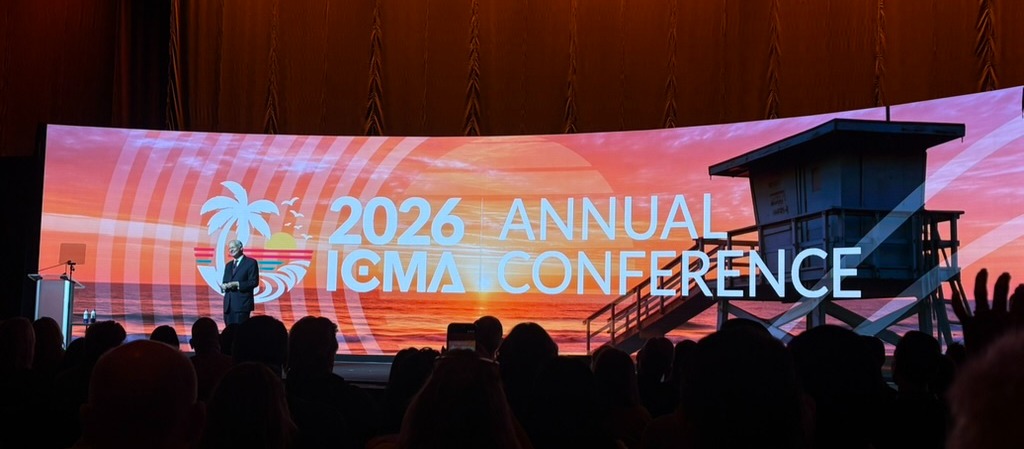
This idea stayed with me after attending the International City/County Management Association (ICMA) Annual Conference in Long Beach, where city managers and local government leaders gathered for several days of seminars, conversations, and opportunities to learn from one another. As a Master of Public Policy and Administration (MPPA) student, I was interested in hearing how leaders approach the challenges facing their communities. But a common theme emerged across the conference, particularly in the keynote addresses from Simon Sinek and Jon Meacham: the importance of curiosity, humility, and a willingness to keep learning.
These qualities are not just useful for individual leaders. They are essential to building effective institutions, navigating disagreement, and sustaining democracy itself.
Culture by Design, Not by Default
Simon Sinek is a popular author and inspirational speaker on business leadership, known for his books Start with Why and Leaders Eat Last. In his Fireside Chat on stage at ICMA, he emphasized that we have a choice between creating a culture by design or allowing one to develop by default. If we do not actively shape the cultures we work and live in, they will shape themselves, and not necessarily in ways that serve us well.
For local government leaders, organizational culture influences how employees communicate, approach problems, and respond to change. A culture that discourages questions can make it difficult to adapt, while one that encourages curiosity creates room for people to identify problems and work toward solutions.
Sinek highlighted curiosity and humility as two of the most important human skills in leadership. These are qualities we often discuss in the context of personal relationships and effective communication, yet they are just as important in professional settings and public service.
Curiosity requires us to ask questions before making assumptions (judgment does the opposite). When we decide we already understand someone or their perspective, we begin labeling rather than listening. Humility reminds us that none of us has all the answers, regardless of our position or experience. Good leaders recognize what they do not know, seek out different perspectives, and remain open to changing their minds.
For public servants, these skills are especially valuable. Local governments serve communities with different experiences, needs, and priorities. There is rarely a single solution that works for everyone. Curiosity allows leaders to understand those differences rather than make assumptions about what their communities need.
Disagreement Is Not the Same as Division
Meacham, Pulitzer Prize-winning biographer, historian, and bestselling author known for his work on American history and political leadership, connected these ideas to the broader challenge of sustaining democracy. He noted that the United States has long been closely divided politically, with almost every presidential election since our inception coming down to something resembling a 49/51 split. Disagreement is not new to American democracy, nor is it inherently a problem. A democratic society depends on people being able to hold different views, debate ideas, and challenge those in power.
The danger comes when we stop seeing those with whom we disagree as fellow citizens and begin treating them as enemies. An adversary is someone whose position we oppose. An enemy is someone we believe must be destroyed. Those are fundamentally different ways of approaching disagreement. Democracy requires us to coexist with people whose views may differ significantly from our own. When every disagreement becomes a battle between people who believe the other side has no legitimate place in society, there is little room left for compromise or collective problem-solving.
This is where curiosity becomes more than a leadership tool. It becomes a civic responsibility. We do not have to agree with someone to try to understand their perspective. Listening does not mean surrendering our principles, just as seeking common ground does not mean abandoning our values. Meacham reflected on the difficulty of loving one’s neighbor. It is a familiar lesson, but one that remains remarkably difficult to put into practice. If treating others with compassion came naturally, perhaps we would not need to be reminded to do it so often.
For local government leaders, this challenge plays out every day as they work with residents, colleagues, and elected officials who may have very different ideas about what their communities need. The ability to listen, remain open to new information, and work through disagreement is essential to serving the public effectively.
A More Perfect Union
One of my favorite takeaways from the conference came from a conversation with my friend and classmate Jharie, who is originally from the Philippines. Having experienced government in a different national context, she brought a perspective that reminded me not to take the everyday functioning of our public institutions for granted. As we left the conference together, she shared how encouraged she was to see so many people genuinely committed to improving their communities and finding ways to serve the public better. It struck me that, despite the challenges facing our democracy, there is something meaningful about having people who continue to show up, ask questions, and work toward something better.
Her perspective gave me a reason to step back and appreciate something that can be easy to overlook. At a time when political discourse can feel overwhelmingly divisive, local government professionals had gathered in Long Beach to learn from one another, discuss difficult challenges, and explore ways to serve their communities more effectively.
Of course, our institutions do not always work as they should, and there is no shortage of problems to solve. But the willingness to acknowledge those shortcomings and work toward solutions is important in itself. The United States was founded on the aspiration to form a “more perfect Union.” This aspiration acknowledges that in some ways, our institutions will fall short, our communities will face new challenges, and we will inevitably disagree about how to move forward. But we can learn, ask better questions, listen more carefully, and recognize that our own perspective is never the only one worth considering.
Just like the theory behind “pothole politics,” which emphasizes the importance of focusing on the everyday services people rely on and delivering them well, sometimes the solutions are right in front of us. New York City Mayor Mamdani recently took this idea literally with his “Pothole Blitz”, by mobilizing the Department of Transportation crews to complete a week worth of repairs in just one day. While filling potholes might seem simple, it was a way he could signal to his constituents that he was listening and wanted to make a tangible difference in their lives by prioritizing the basics. In a political climate often dominated by partisan divisions and big promises, consistently delivering the everyday services people depend on is one way local governments can demonstrate their value and rebuild public trust.
As an MPPA student, I left the conference thinking about how these lessons apply not only to the people who manage our cities and counties, but to anyone who wants to contribute to public life. Curiosity helps us understand the systems we depend on, humility reminds us that there is always more to learn, and a willingness to engage with people who think differently keeps the door open to progress.
Democracy is not a finished product. Neither is leadership, nor the work of building a community where people can thrive. Success is not about reaching a point where nothing needs to change. It is about continuing to show up, learn from one another, and make things a little better than they were yesterday.